

India’s $180B Data Center Boom: The 2026 AI Investment Guide
The 30-Second Sip: India generates 20% of the world’s data but houses just 3% of global data centre capacity. That gap is now the target of one of the largest coordinated India AI data center investment 2026 waves in history — with $67.5 billion committed by global hyperscalers (AWS, Microsoft, Google), $11 billion pledged by Blackstone, and cumulative capital commitments crossing $126 billion in 2025 alone. By end of 2026, total projected commitments are expected to surpass $180 billion. Jensen Huang calls these facilities “AI factories.” Whoever builds and operates them in India will shape the digital economy for the next two decades. Here is what you need to understand — and why it matters far beyond technology.
There is a race happening right now. Not between athletes. Between nations.
The prize is not land or oil. It is compute power — the ability to run artificial intelligence at scale. And in 2026, India has become the most strategically attractive destination for that compute power in the world.
Global technology giants, sovereign wealth funds, and private equity behemoths are collectively committing hundreds of billions of dollars to build AI-ready data centres on Indian soil. This is not aspiration — the commitments are signed, the land is acquired, and the construction is already underway in Mumbai, Chennai, Hyderabad, and Pune.
For Indian investors, business owners, and families, this India AI data center investment 2026 wave is not a distant infrastructure story. It is a structural shift that will reshape cloud costs for Indian businesses, generate new yield-bearing investment instruments, and create demand for power, cooling, and construction across the economy.
At Gyani Turtle, we cut through the announcement headlines and give you the mechanism — how global capital flows into Indian data centres, who builds them, who benefits, and what a patient investor should think about this shift.
The Data Gap That Is Driving $180 Billion in Capital
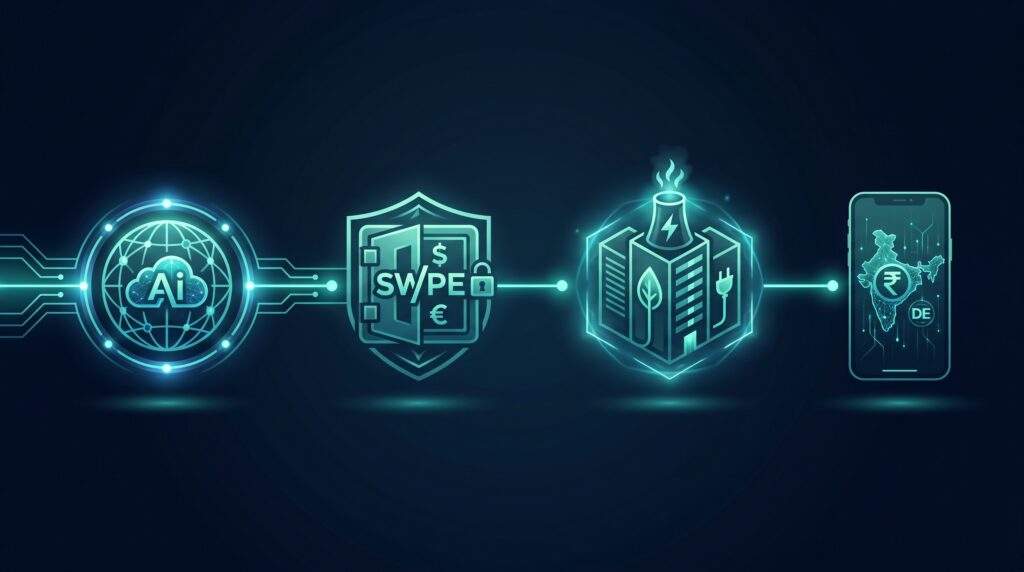
The single most important number in this entire story is not $180 billion. It is the ratio: 20% vs 3%.
India generates approximately 20% of the world’s data — from 1.4 billion mobile users, one of the world’s largest UPI payment networks, the fastest-growing streaming market, and an exploding enterprise software ecosystem. Yet India currently houses only about 3% of global data centre capacity. This gap — between data generated and compute infrastructure to process it — is the structural foundation of the entire investment thesis.
According to official Ministry of Electronics and IT (MeitY) data reported in March 2026, India’s colocation data centre capacity reached approximately 1.5 gigawatts by end-2025 — with the Avendus Capital May 2026 report citing a figure as high as 1.6 GW. Projections from CARE Ratings and sector analysts point to expansion toward 4 gigawatts by 2030 — a near-threefold increase from the current baseline. To put that in perspective: building one gigawatt of AI-ready data centre capacity at Indian construction costs ($6 million per MW, compared to $8–12 million per MW in the US) requires over $6 billion in capital. Four gigawatts means tens of billions in physical construction alone, before you account for GPUs, cooling systems, and power infrastructure.
This is why capital is moving. India’s India AI data center investment 2026 pipeline is not hype — it is rational institutional response to a verifiable supply gap in the world’s third-largest economy.
Here are the confirmed capital commitments:
|
Investor |
Commitment |
Confirmed? |
|---|---|---|
|
Amazon Web Services |
$35 billion |
✅ Confirmed |
|
Microsoft |
$17.5 billion |
✅ Confirmed |
|
|
$15 billion |
✅ Confirmed |
|
Blackstone Inc. |
$11 billion |
✅ Confirmed |
|
Total Hyperscaler Pledges |
$67.5 billion |
✅ Confirmed |
|
Cumulative industry commitments |
$126 billion (2025 baseline) |
✅ Confirmed |
|
Projected total by end-2026 |
$180 billion |
⚠️ Projected |
In-body disclosure: Companies mentioned above are referenced as historical illustrative examples only. This does not constitute a recommendation. Gyani Turtle and its authors may or may not hold positions in securities mentioned as educational examples.
The Transmission Chain: From Global AI Race to Your Portfolio

Understanding why this capital is moving to India requires tracing the full chain — from the boardrooms of Silicon Valley to a data centre on the outskirts of Navi Mumbai.
Step 1 — The Global AI Arms Race: The competition to build and deploy large language models, autonomous agents, and AI-driven enterprise software demands unprecedented compute power. Training a single frontier AI model can consume more electricity than a small town for months. This forces every major technology company to seek massive, scalable GPU-powered infrastructure.
Step 2 — The Developed Market Bottleneck: Data centres in the United States and Europe are running into hard physical limits. Power grids in Virginia, London, and Amsterdam are saturated. Environmental regulators in the EU have begun restricting the water consumption and land use of new hyperscale facilities. The US-China technology decoupling has made Taiwan-adjacent geographies uncomfortable for sensitive compute workloads. Developed market capacity cannot scale fast enough to meet demand.
Step 3 — The Capital Pivot to India: Institutional investors — Blackstone, GIC, Brookfield, and sovereign wealth funds globally — recognise that India offers cheaper construction costs, 20-year tax holidays on data centre infrastructure, a massive under-penetrated digital market, and a government actively investing in the ecosystem through the IndiaAI Mission. The capital pivot is rational, not sentimental.
Step 4 — Domestic Infrastructure Buildout: Indian real estate conglomerates, the National Investment and Infrastructure Fund (NIIF), and domestic power companies form joint ventures with global operators to build Tier-IV, AI-ready “Powered Shells” — large-scale facilities pre-wired for high-density GPU racks — in Mumbai, Chennai, Hyderabad, and Bengaluru.
Step 5 — The Enterprise Benefit: When compute capacity exists locally, Indian businesses and startups no longer need to pay dollar-denominated overseas server costs or absorb the latency of routing data halfway around the world. Cloud hosting costs fall. AI model training becomes accessible to Indian firms that previously could not afford it. A new class of Made-in-India AI products becomes economically viable.
Step 6 — The Household and Portfolio Impact: Retail investors gain access to new yield-bearing infrastructure instruments — data centre REITs and InvITs. Indian families benefit from faster digital services. Direct employment is created in construction, operations, power infrastructure, and related technology services.
As Jensen Huang, CEO of Nvidia, noted in a global industry address: modern AI-driven data centres are best understood as “AI factories” — not passive storage facilities, but active production plants generating economic output. Whoever controls these factories will shape the cost, speed, and direction of the global AI economy.
The Rahul Sharma Story: Two Choices, Two Very Different Businesses
This is an illustrative scenario for educational purposes only. Not investment advice. All figures are approximate and for illustration only.
Rahul Sharma (34), Pune, Maharashtra. Founder of an MSME logistics software platform. Annual income: ₹35 Lakhs. Business revenue: ₹2.5 Crores.
❌ The Wrong Choice — The Legacy Offshore Model
Rahul hosts his company’s data and AI routing algorithms on US-based cloud servers. He pays $6,000 per month. At ₹84 per dollar, this costs his business ₹5,04,000 per month — over ₹60 Lakhs annually.
When the Rupee weakens (as it has repeatedly in 2025–2026), his operational costs spike without warning. Cross-continental latency slows his software’s real-time fleet tracking, frustrating his Indian clients. His dollar-denominated costs are also unhedged — every depreciation cycle eats into his operating margin.
National impact: Every dollar Rahul sends to a US cloud provider is a dollar that leaves India’s economy. Multiplied across thousands of Indian MSMEs, this is a measurable contribution to India’s Current Account Deficit.
✅ The Right Choice — The Localised AI Infrastructure Model
Recognising the shifting landscape, Rahul migrates his operations to a newly built hyperscaler-backed AI data centre in Navi Mumbai. His monthly hosting cost drops to ₹3,10,000 — a saving of ₹1,94,000 per month, or over ₹23 Lakhs annually. He eliminates currency fluctuation risk entirely, reduces latency by approximately 70%, and reinvests the capital saved into hiring two local software developers.
National impact: Rahul’s rupee payments stay inside the Indian economy. The data centre operator pays local power companies, construction workers, and engineering staff. The domestic multiplier activates.
The only difference between these two businesses is awareness of a structural shift that is already underway.
The Investment Landscape: What Vehicles Actually Exist
Understanding the India AI data center investment 2026 landscape requires distinguishing between asset classes. Here is an honest comparison of how different investor types have historically thought about infrastructure exposure:
|
Feature / Metric |
India Context |
Global Benchmark |
Investor Implication |
Risk Level |
|
Data Gap (Generation vs Capacity) |
20% data, 3% capacity |
US: ~40% capacity share |
Structural runway for expansion |
Low |
|
Construction Cost per MW |
~$6 million |
$8–12 million (US/EU) |
Higher capital efficiency |
Medium |
|
GPU Deployment IRR (projected) |
~28% (Avendus, May 2026) |
15–20% (global) |
Premium return potential — but a projection |
High |
|
Power Sourcing |
Targeting 50%+ renewable by 2030 |
Strict ESG mandates (80%+) |
Green energy JVs required |
High |
|
Retail Investment Vehicles |
Emerging REITs & InvITs |
Mature, liquid REIT markets |
Early-stage entry, limited liquidity |
Medium |
According to Avendus Capital’s May 2026 report, the AI infrastructure investment opportunity in India over the next five years is estimated at $23 billion, with 650,000 to 700,000 GPUs projected for deployment in domestic data centres. These are analyst projections, not guarantees — but they reflect the scale of institutional conviction behind the India AI data center investment 2026 wave.
Vaibhav Garg, Director of Infrastructure at Avendus Capital, noted: “AI adoption is emerging as a significant catalyst for next-generation infrastructure investments in data centers, alongside sustained demand from cloud and digital workloads.”
What the Government Is Actually Building
The private capital story is only half the picture. India’s public sector is not a passive bystander in the India AI data center investment 2026 buildout — it is an active co-architect.
The IndiaAI Mission, backed by the Ministry of Electronics and Information Technology (MeitY) and NITI Aayog, has committed ₹10,372 crores to domestic AI compute infrastructure, securing over 38,000 GPUs for government-accessible AI workloads. This direct state investment reduces the risk profile for private sector co-investors and signals long-term policy continuity.
SEBI, meanwhile, has been systematically liberalising the regulatory framework for REITs and InvITs — making it progressively easier for global private equity to recycle capital and for domestic retail investors to participate in infrastructure assets that were previously accessible only to institutions.
Goldman Sachs and Morgan Stanley have both published research framing India as “the next decade’s infrastructure play,” citing demographic digital adoption and geopolitical supply-chain diversification as structural tailwinds.
In-body disclosure: SEBI, MeitY, Goldman Sachs, Morgan Stanley, Avendus Capital, and CARE Ratings are referenced as institutional sources for historical and projected data only. This is not a recommendation related to any of these entities.
The Honest Counter: What the Critics Get Right
At Gyani Turtle, we never oversell. India’s India AI data center investment 2026 story has real structural merit — but the skeptics raise valid concerns that every investor should understand before forming a view.
The Energy and Water Problem: Data centres are among the most energy and water-intensive facilities in modern infrastructure. Critics warn that building 4–5 GW of capacity in a country that still faces peak-summer power deficits and water scarcity in Chennai and Mumbai creates genuine civic and ecological strain. A data centre that cannot guarantee uninterrupted power is not Tier-IV — it is a liability.
Commitments vs Construction: $180 billion in investment “pledges” is not $180 billion deployed. Acquiring contiguous land in urban India, securing long-term green power purchase agreements (PPAs), and navigating state-level regulatory approvals has historically stretched Indian infrastructure timelines by years. Global contrarians correctly note that actual returns depend on execution, not announcement.
The Hardware Import Dependency: India’s data centre buildout relies almost entirely on imported hardware — advanced Nvidia GPUs, specialised cooling units, optical networking equipment. This exposes the sector to global supply chain bottlenecks, hardware export controls, and tariff risk. A US-India trade disruption affecting semiconductor exports could materially delay deployment timelines.
The Job Creation Question: Critics note that hyperscale data centres, once built, are highly automated and employ surprisingly few operational staff. The primary employment benefit is in construction and ancillary services — not long-term, high-skill technology employment.
These are legitimate risks. The structural thesis remains compelling. But conviction without awareness of these constraints is not investing — it is speculation.
How Different Market Participants Evaluate This Theme
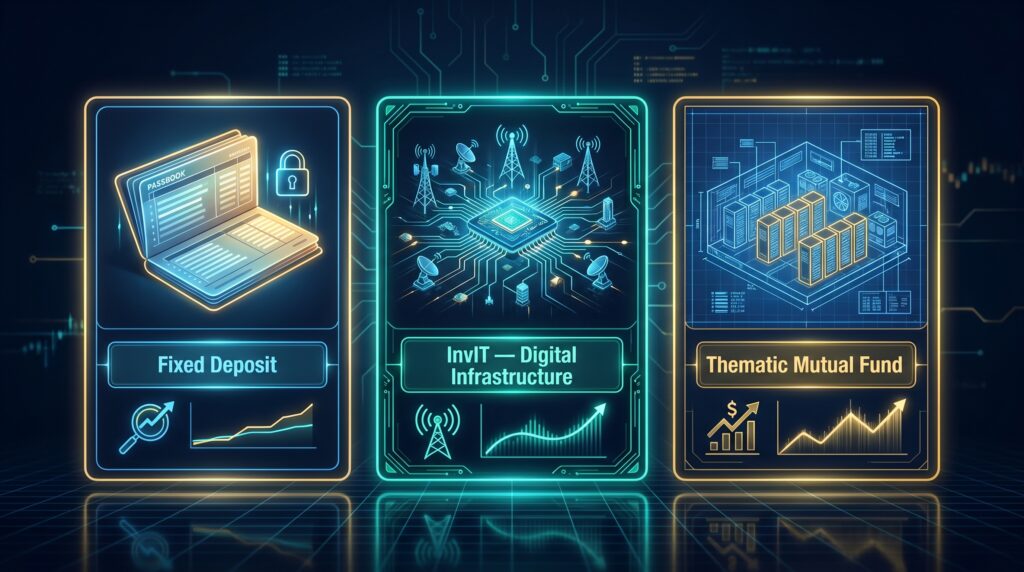
Salaried professionals and long-term equity investors: The India AI data center investment 2026 theme represents a legitimate long-term structural story — but the sector is highly cyclical, capital-intensive, and execution-dependent. Market participants have historically categorised digital infrastructure as a thematic satellite allocation rather than a core portfolio holding, given its sensitivity to interest rates, regulatory timelines, and hardware supply chains. Investors tracking this space have explored thematic mutual funds covering digital infrastructure, telecom, and power generation as a basket approach — providing broad sector exposure without concentrated single-asset risk.
MSME business owners and operators: Indian MSMEs are increasingly evaluating their current cloud architecture in light of the data centre buildout. For businesses paying dollar-denominated cloud costs for workloads that are primarily Indian-market-facing, the economic case for migrating to domestic infrastructure has strengthened considerably — reducing both absolute hosting costs and unhedged currency exposure. The Rahul Sharma scenario above is illustrative; the underlying cost differential is a pattern that technology analysts and CFOs across Indian MSMEs are actively examining.
Retail investors and individual savers: The emerging wave of data centre-related infrastructure instruments — InvITs leasing powered shells to global hyperscalers, and potentially listed REITs as the asset class matures — represents a category that analysts and market participants have begun to examine for yield diversification. Historically, infrastructure-focused InvITs in India have targeted distribution yields in the 7–9% range. These instruments carry materially different risk profiles from equity — including illiquidity risk, interest rate sensitivity, construction execution risk, and long-dated cash flow dependency — and market participants typically conduct detailed due diligence before forming a view.
NRIs and globally mobile Indians: NRIs are examining this theme through the lens of NRE-funded investments into Indian infrastructure funds. The NRE account structure allows for tax-free repatriation of principal and post-tax returns, which mitigates the currency risk that purely foreign institutional investors face. The Double Taxation Avoidance Agreement (DTAA) between India and many NRI-resident countries may allow tax credits on Indian withholding taxes applied to REIT or InvIT distributions — the specifics vary significantly by country of residence and require consultation with a qualified cross-border tax professional. Note: The Liberalised Remittance Scheme (LRS) governs money moving out of India; NRIs bringing capital into India are not subject to LRS limits.
Families managing multi-generational wealth: Long-horizon wealth managers have historically approached high-capital-intensity infrastructure themes through what practitioners call the “pick-and-shovel” lens — studying the ancillary industries that supply every data centre regardless of which operator wins the market. Every hyperscale facility requires industrial cooling systems, fibre-optic cable networks, uninterrupted power supply infrastructure, and green energy generation capacity. These adjacents have historically offered broader economic exposure to an infrastructure build cycle with somewhat lower concentration risk than direct asset ownership.
The Gyani Turtle Verdict

The India AI data center investment 2026 story is structurally one of the most compelling infrastructure themes in any emerging market globally. The data gap is real. The capital commitments are confirmed. The government tailwinds are genuine. And the transmission chain — from global AI demand to Indian infrastructure to domestic business productivity — is already in motion, not theoretical.
But this is a long-duration, capital-intensive, execution-dependent theme. The 20% data / 3% capacity gap will not close in one year. The $180 billion in projected commitments will not all materialise on schedule. And the regulatory, power, and hardware risks are not trivial.
Here is the Gyani Turtle framework for thinking about this theme:
- Understand the mechanism — the structural supply gap and why global capital is rationally attracted to it — before any investment decision
- Distinguish commitments from deployment — announced capital and operational capacity are very different numbers in Indian infrastructure
- Understand the asset class — infrastructure is historically a cyclical satellite allocation, not a replacement for core index exposure in any equity portfolio
- The pick-and-shovel adjacents — power infrastructure, industrial cooling, and optical networking have historically offered lower-risk exposure to infrastructure build cycles than direct asset ownership
- NRE account structure — NRIs examining this theme will find the NRE account provides a structurally favourable entry mechanism; the DTAA position relative to one’s country of residence determines the full tax picture
- Never confuse a compelling narrative with a guaranteed return — the IRR projections are analyst estimates, not contractual commitments
India is building the infrastructure that will run the Indian economy’s AI future. That is worth understanding deeply — whether or not it ends up in your portfolio.
Invest patiently. Analyse deeply. React rarely.
That’s the Gyani Turtle way. 🐢
Also read:
- How to Use Agentic AI in Investment and Trading — A Complete Guide for Indian Investors
- Is Your TCS SIP Safe? 5 Truths About AI and India’s IT Stocks in 2026
- The White Collar Recession Nobody Is Talking About
- How to Start Investing in India as a Beginner (2026 Complete Guide)
This article is for educational purposes only. All projected figures are clearly marked and do not constitute investment advice or a guarantee of future performance. Gyani Turtle is not a SEBI-registered Investment Adviser. No part of this analysis constitutes a buy, sell, or hold recommendation for any specific equity, derivative, REIT, or corporate instrument. All named companies are referenced for macroeconomic illustration only. Please consult independent SEBI-registered financial advisors and legal professionals before making any investment or cross-border asset allocation decisions.

At Gyani Turtle, we believe every Indian deserves access to honest, jargon-free financial education. Our team simplifies investing, mutual funds, and personal finance — so you can build real wealth, one smart decision at a time. Not SEBI registered. For educational purposes only.






2 Comments