The Indian Companies Quietly Winning the AI Gold Rush — Before Everyone Else Notices
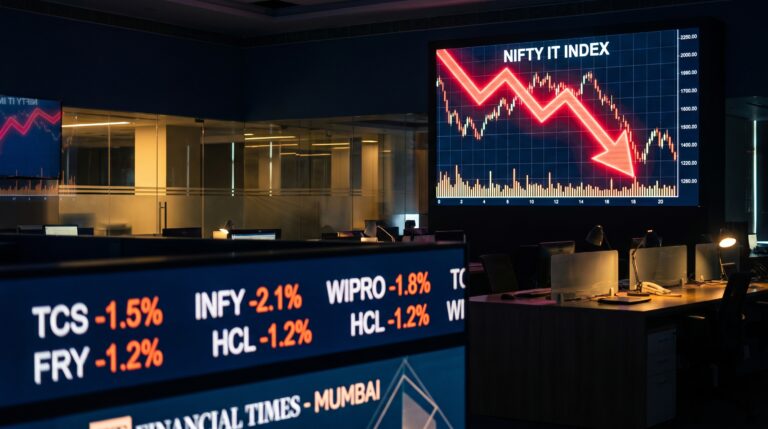
The Nifty IT index fell 25% in 2026. TCS lost 23,460 employees. Wipro’s CEO used the word “deflation.” Every headline was a funeral. If you were looking for the best AI stocks India 2026 has quietly produced, they were hiding in plain sight
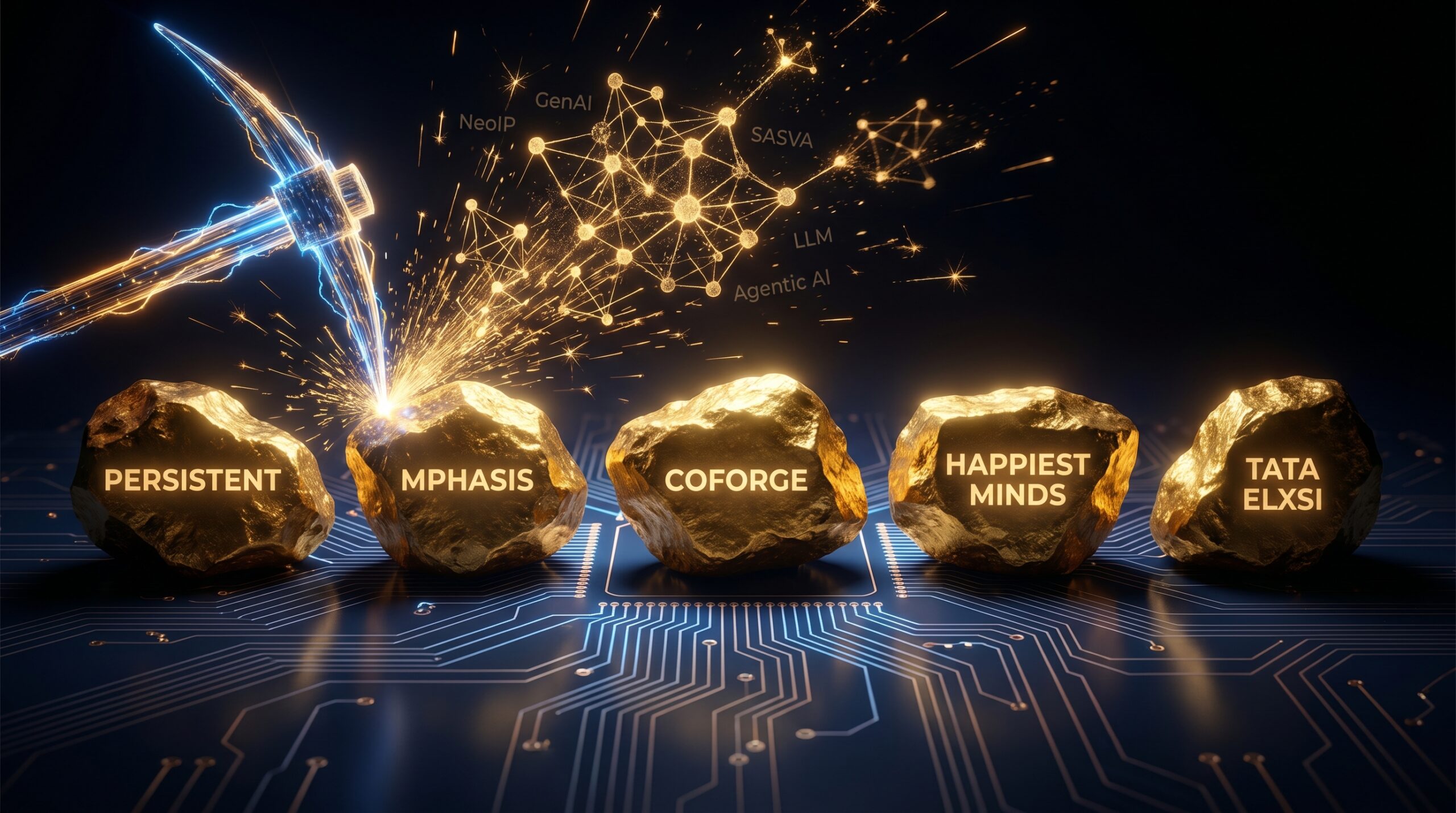
And yet — they were hiding in plain sight. Five Indian companies growing at double digits. Consistently. Without drama. While the index bled.
We have already covered why TCS investors should worry and what the white collar recession means for India’s middle class. This post is the other side of that story: who is actually winning — and why.
Why Mid-Caps Are the Best AI Stocks India 2026 Isn’t Talking About

Large-cap IT — TCS, Infosys, Wipro, HCL — built their moat on scale. Thousands of engineers, bulk headcount, time-and-material billing. AI is dismantling that moat. When you can deliver with 10 people what required 100, scale becomes overhead.
Mid-cap IT firms never relied on headcount arbitrage. They built on engineering depth, vertical expertise, and outcome-based delivery — exactly what AI amplifies rather than replaces.
The market backs this up with hard numbers:
- India’s AI market is projected to hit $7–8 billion in 2026 and $35 billion by 2032 (CAGR ~30%)
- India ranks #1 globally in AI skill penetration
- 87% of Indian enterprises are actively adopting AI
The pie is expanding — and mid-caps are eating a disproportionate slice. Here are the five companies the headlines are missing.
1. Persistent Systems — The World’s Fastest-Growing IT Brand
FY26 revenue: $1,654.4 million. Growth: +17.4% YoY. Consecutive quarters of growth: 24.
While TCS revenue slipped 0.5%, Persistent delivered its 6th straight year of unbroken quarterly growth. Brand Finance named it the fastest-growing IT services brand globally in 2026 — not in India. In the world.
What is driving this:
Its proprietary SASVA 3.0 platform — an AI-powered engineering tool automating architecture design, code generation, and testing — is the engine behind the numbers. Microsoft named Persistent a “Frontier Firm” for genuine production-scale AI deployment, not experimental pilots.
Sector-level returns confirm the quality of growth:
- BFSI: +30.7% YoY
- Healthcare: +12.4% YoY
- Software & Hi-Tech: +14.1% YoY
All premium, complex verticals where AI commands better pricing — not commodity work.
Target: $2 billion in revenue by FY27 — a 21% step up, extrapolated from six years of consistent delivery.
Valuation check:
~62x earnings. Growth quality justifies a premium, but at this multiple, any stumble gets punished. Buy on dips, not peaks.
2. Mphasis — Where 60% of Every New Deal Is AI
Mphasis is not a retail investor household name. That gap between obscurity and performance is exactly where the opportunity lives.
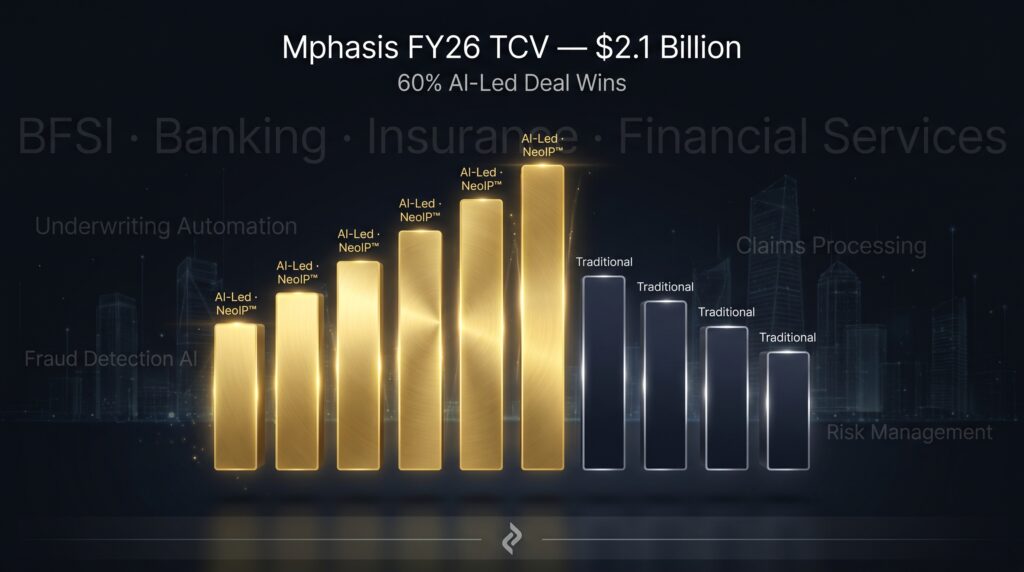
FY26 numbers: $1.79 billion revenue (+11.6% YoY). Q4 alone grew 14.4% YoY and 6% QoQ. Operating margin: 15.3%. Full-year New TCV: $2.1 billion — the highest in company history — with 60% AI-led. In Q4 alone, 64% of the $407 million in TCV was AI-led.
This is not slide-deck AI. The revenue proves it.
The product behind the numbers: NeoIP™ — a proprietary AI suite for BFSI clients automating underwriting, fraud detection, and claims processing. Mphasis recently acquired Theory and Practice (TAP) for decision intelligence, and the board declared a ₹62/share dividend while reappointing CEO Nitin Rakesh for five more years. Both are signals of confidence, not caution.
Valuation check:
More reasonable than Persistent. A company with 60% AI-led deal wins growing at 11.6% deserves attention — especially when it flies under the radar.
3. Coforge — 31% Revenue Growth. Zero Headlines.
Coforge grew revenue 31% in FY25 — the highest rate among any Indian IT firm above $1 billion. Almost nobody was talking about it.
Q3 FY26 revenue: ₹4,188 crore ($478M). Q3 TCV: $593 million. The number that matters most: its 12-month executable order book stands at $1.72 billion — up 30% YoY. That backlog tells you what FY27 revenue looks like before the quarter even begins.
Coforge’s edge is vertical concentration — BFSI, insurance, travel, digital services. In a market where generic IT is being commoditised by AI, deep domain expertise is the last durable differentiator. The landmark Sabre deal anchored its travel vertical with one of the world’s largest travel technology companies.
Valuation check:
Execution and acquisition integration are real risks. But a 30% growing order book is a fact — not a projection.
4. Happiest Minds — India’s Most AI-Native IT Company
Founded by Ashok Soota (founder of MindTree), Happiest Minds was built AI-first from inception — not retrofitted.
That combination alone puts Happiest Minds firmly in the conversation for the best AI stocks India 2026 investors should be tracking.
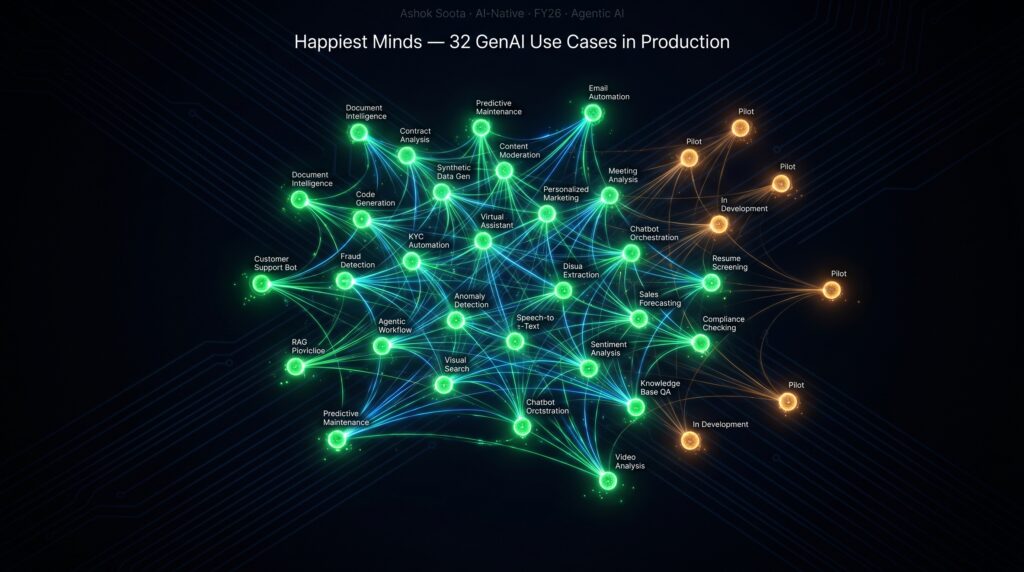
Q3 FY26: +10.7% YoY revenue. Its Generative AI Business Services segment: +50% QoQ — the fastest-growing segment in any Indian mid-cap IT firm this year. The company has moved 32 GenAI use cases from prototype to production, with a $50 million generative AI revenue pipeline over three years.
Margins: 20–22% EBITDA — among the highest in Indian mid-cap IT. This combination of margin quality with double-digit growth is rare. Chairman Soota has committed to four consecutive years of 10%+ growth, with 30 new clients added in H1 FY26 representing $50–60 million in three-year revenue potential.
Valuation check:
Smaller scale (~$260M revenue) means higher concentration risk. But for a patient 5-year investor, the AI-native architecture and margin discipline make this worth watching closely.
5. Tata Elxsi — AI for the Physical World
Tata Elxsi plays a different game entirely. While others automate digital workflows, it embeds AI into physical products — autonomous vehicles, intelligent streaming platforms, AI-assisted medical devices.
FY26 revenue: ₹3,757.4 crore. PBT margin: 23.4%. ROE: 34.62%. ROCE: 46.60%. Zero debt. These are not IT services metrics. These are industrial-quality returns from a design and engineering company.
The structural protection: OpenAI and Anthropic cannot build an AI algorithm inside a next-generation automotive infotainment system. Tata Elxsi can. That intersection of hardware, design, and AI is a niche generic tools do not threaten.
Near-term softness is real — Q4 FY26 grew just 4.2% QoQ, and the EV segment has been slower than expected. But the long-term thesis is intact.
Valuation check:
Not cheap. The premium is earned. Quality at a fair price always beats a bargain in a deteriorating business.
Here is how all five stack up — a full comparison of what make these the best AI stocks India 2026 mid-cap space has to offer:
|
Company |
FY26 Revenue Growth |
Key AI Metric |
Margin |
Watch For |
|---|---|---|---|---|
|
Persistent |
+17.4% |
24 consecutive growth qtrs |
15.6% EBIT |
Valuation at 62x |
|
Mphasis |
+11.6% |
60% of $2.1B TCV = AI |
15.3% |
Deal conversion in FY27 |
|
Coforge |
+31% (FY25) |
$1.72B order book +30% |
Stable |
Acquisition integration |
|
Happiest Minds |
+10.7% |
32 GenAI cases in production |
20-22% EBITDA |
Client concentration |
|
Tata Elxsi |
+4.2% QoQ |
AI in physical products |
23.4% PBT |
EV segment recovery |
|
TCS (benchmark) |
-0.5% |
$2.3B AI (5-6% of total) |
25.2% |
Structural transition |
|
Nifty IT |
— |
— |
— |
-25% YTD |
How to Invest in the Best AI Stocks India 2026 Has Produced
Rule 1 — AI revenue beats AI narrative.
Mphasis saying 60% of TCV is AI-led is an auditable fact. A company saying “we are AI-enabled” is marketing. Demand the number, not the story.
Rule 2 — Order books predict; revenue reports.
Coforge’s $1.72 billion backlog tells you more about FY27 today than any quarterly result will tell you in October. Learn to read forward indicators.
Rule 3 — Size your position for the valuation risk.
These stocks are not cheap. A 3–5% satellite allocation captures the upside without making a single bad quarter catastrophic to your portfolio.
Rule 4 — Diversify within the theme.
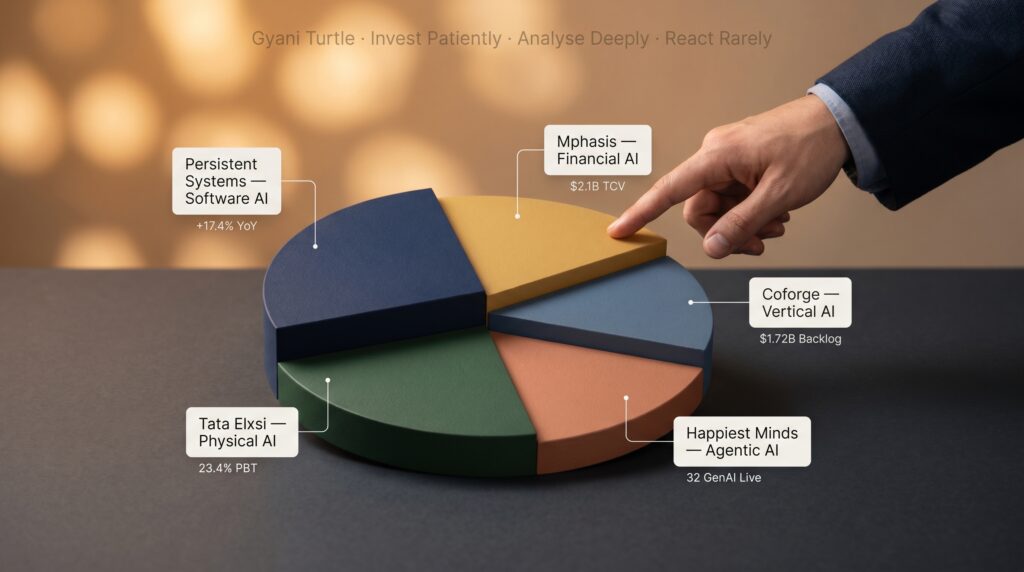
Persistent = software AI. Mphasis = financial AI. Tata Elxsi = physical AI. Happiest Minds = agentic AI. Coforge = vertical AI. Owning all five is genuinely different risk exposure — not redundant concentration.
The simplest route:
If you do not want to pick individual stocks, check whether your mid-cap mutual fund holds Persistent, Mphasis, or Coforge before assuming your IT exposure is positioned for this cycle. Most large-cap IT funds are not.
The Gyani Turtle Verdict
The best AI stocks India 2026 has to offer are not the ones on every news ticker.
TCS is the loudest story in Indian IT. Persistent is the fastest-growing IT brand in the world.
Mphasis signed $2.1 billion in AI-led contracts. Coforge grew 31% in a year the sector fell 25%. Happiest Minds moved 32 AI use cases into production while the index hit 30-month lows.
The AI gold rush is not coming. It is already here. The question is whether you are watching the headcount cuts — or watching the order books grow.
Invest patiently. Analyse deeply. React rarely.
That’s the Gyani Turtle way. 🐢
Also read:
- How to Use Agentic AI in Investment and Trading — A Complete Guide for Indian Investors
- Should Indian Investors Invest in China’s Stock Market in 2026?
- Is Your SIP Nifty IT Safe? 5 Truths About AI and India’s IT Stocks in 2026
Disclaimer: This article is for educational purposes only and does not constitute investment advice. Please consult a SEBI-registered advisor before making investment decisions.

At Gyani Turtle, we believe every Indian deserves access to honest, jargon-free financial education. Our team simplifies investing, mutual funds, and personal finance — so you can build real wealth, one smart decision at a time. Not SEBI registered. For educational purposes only.