

The White Collar Recession Nobody Is Talking About — AI, Indian IT, and the ₹80,000 Crore Question
There is a recession happening in India right now.
It does not show up cleanly in GDP numbers. The IMF still says India is the fastest-growing large economy in the world. The Sensex has its good weeks. Real estate prices in Bengaluru and Hyderabad are holding firm. On the surface, India’s growth story appears intact.
But if you talk to a 2024 engineering graduate still waiting for their joining letter — or a mid-level IT manager who has just been asked to “transition” out of their role — or a family in Pune that bought a home on the back of two IT salaries that are now under threat — you will hear a very different story.
“I spent 4 years studying Java and C++. My reward? A joining letter delayed three times and a starting salary that pays less than my father made in 2005.”
Anirudh, Engineering Graduate, 2025
It is a white collar recession. Not the kind where factories shut down and unemployment spikes overnight. The slow kind. The kind that hollows out the economic foundation quietly, over months and years, before the broader economy notices.
The data — when you actually look at it — makes India’s white collar recession in 2026 impossible to dismiss.
🐢 TURTLE’S RAPID RESPONSE
- IT professional? Upskill into AI/ML now — salary gap is ₹3.36 LPA vs ₹12 LPA
- Fresher? Target GCCs over traditional IT services — better pay, more stable
- Investor? IT corridor real estate and consumer discretionary carry new risk
- SIP holder? Hold through diversified funds — don’t exit, recalibrate
The ₹80,000 Crore Question: What Is Actually at Stake

Before we go further, let us define the number in the headline — because it is not arbitrary.
India’s ICT-BPM sector employs 5.4 million people and contributes 7.5% of GDP. These are not entry-level gig workers. These are engineers, analysts, project managers, and consultants — India’s aspirational middle class — earning ₹8–25 LPA, paying EMIs on flats in Whitefield and Hinjewadi, sending children to private schools, taking annual flights, and driving consumer spending across the economy.
Bernstein — the global equity research firm — put it plainly in an open letter to Prime Minister Modi in April 2026: “10 to 15 million Indians working in IT services and BPO have anchored the aspirational middle class — buying homes, taking flights, driving consumption.“
When you model what happens if even 15–20% of those roles are eliminated or significantly downgraded over five years, the consumer spending that disappears runs to ₹80,000 crore or more annually. That is the combined EMI payments, school fees, discretionary consumption, and savings that India’s white-collar IT workforce generates every year — and that now faces structural risk.
This is not catastrophism. This is arithmetic.
NITI Aayog’s October 2025 roadmap — a government document, not an alarmist blog — frames the stakes in its worst-case scenario: IT services headcount could fall from 7.5–8 million in 2023 to 6 million by 2031. The customer experience sector could shed an additional 200,000–700,000 roles in the same period.
That is potentially 1.5 to 2 million white collar jobs disappearing over eight years in a country that produces 1.5 million engineering graduates every year. The mismatch between supply and demand isn’t a gap — it’s a structural trap.
The Fresher Hiring Collapse: A Generation Locked Out
The most concrete evidence of India’s white collar recession is not in corporate earnings reports. It is in the fresher hiring numbers — and they are staggering.
According to talent analytics firm Xpheno, fresher hiring in India’s IT sector peaked at 600,000 in FY22 — the post-COVID boom year. By FY25, it had fallen to approximately 120,000. An 80% decline in three years.
Four out of every five IT fresher jobs that existed in 2022 have effectively disappeared. The competition for the remaining roles has intensified dramatically — LinkedIn data shows that applicants per open role in India have more than doubled since early 2022.
The top five IT companies — TCS, Infosys, Wipro, HCLTech, and Tech Mahindra — cut a combined net 6,981 jobs in FY26, reversing two years of hiring growth. Their gross hiring dropped from a five-year average of 230,000 annually to just 170,000 in FY26 — a 26% decline in absolute hiring volumes in a single year.
Wipro deferred onboarding for nearly 200 campus recruits by seven months or more — with no clarity on when or whether they would join. Tech Mahindra has approximately 1,000 candidates still waiting for joining letters.
These are not statistics. These are real people — families who planned around an offer letter, paid deposits in new cities, turned down other opportunities — now suspended in uncertainty.
The Gyani Turtle Read:
A generation of engineers graduating between 2022 and 2026 entered the job market at the exact moment the old model of bulk IT hiring began its structural decline. They are not failing. The system changed around them. That distinction matters — both for understanding the problem and for knowing what to do next.
The Salary That Has Not Moved in 20 Years
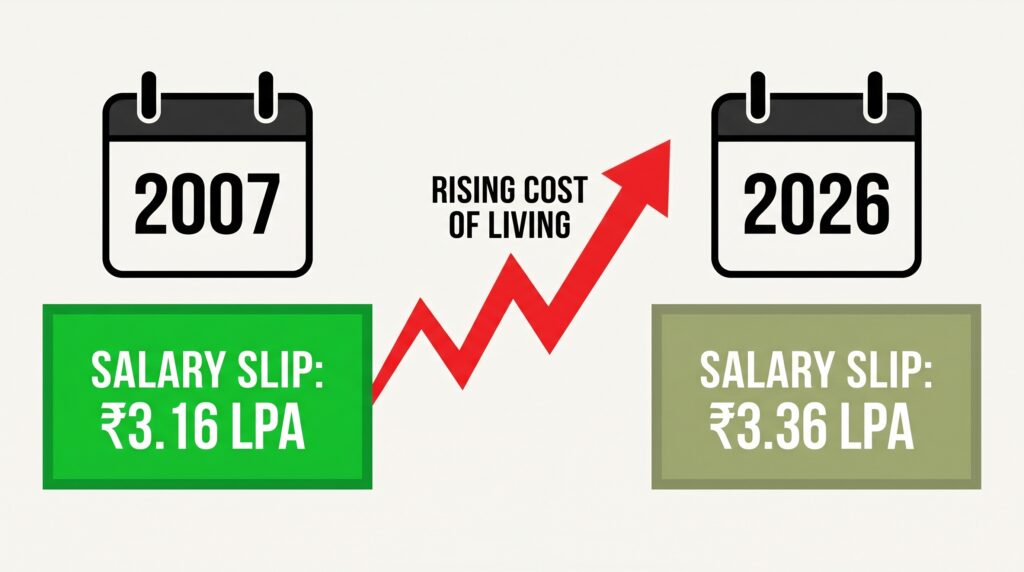
Here is a data point that deserves a full paragraph of silence before you react to it.
A fresher IT salary in India in 2007: ₹3.16 LPA. A fresher IT salary in India in 2026: ₹3.36 LPA.
Nearly twenty years. The revenues of India’s top IT companies have more than doubled. The stock prices have compounded. The promoter wealth has grown enormously. And the entry-level salary for an Indian software engineer has moved by approximately six percent in two decades.
Once you factor in tuition inflation, soaring rents in tech hubs, and rising living costs — the real purchasing power of a fresh IT engineer in 2026 has dropped 50–60% compared to 2007, according to Business Today estimates.
A ₹3.36 LPA salary in Bengaluru in 2026 does not cover rent in Whitefield, let alone savings, EMIs, or a lifestyle that matches the “IT success story” narrative Indian families have been sold for a generation.
The CEO of Shiksha Nation framed it clearly:
“Offering top percentile JEE graduates a starting salary of ₹3 lakh per annum is a wake-up call for India’s education-industry ecosystem. Exceptional academic achievement must translate into fair market value.”
This is a talent pricing problem. India’s top IT firms have more applications than they can process. It is structural wage suppression — one that AI-driven productivity demands are making worse, not better. As AI tools handle more of the routine coding and documentation that freshers previously performed, companies need fewer of them, giving them even less pressure to compete on entry-level compensation.
The result: a generation holding degrees that cost ₹8–15 lakh in fees, entering a job market paying ₹3.36 LPA, in cities where ₹3.36 LPA does not pay the rent.
|
Year |
Fresher IT Salary |
Bengaluru 1BHK Rent |
Inflation-Adjusted Value |
|---|---|---|---|
|
2007 |
₹3.16 LPA |
~₹6,000/month |
~₹9.5 LPA in 2026 terms |
|
2026 |
₹3.36 LPA |
~₹22,000/month |
₹3.36 LPA (no change) |
The Multiplier Problem: Why This Goes Beyond IT
This is where India’s white collar recession becomes a macroeconomic problem — not just a sectoral one.
India’s IT sector does not exist in isolation. It sits at the centre of a consumption multiplier that touches every corner of the modern Indian economy.
When an IT engineer in Hyderabad earns ₹15 LPA, the economy around them runs on it — EMI to developers, school fees to private institutions, restaurant bills, OTT subscriptions, transfers to hometown families. One salary supports five economic relationships.
White-collar IT employment has spillover effects across real estate, education, and services — Bernstein’s letter to PM Modi made this point explicitly, warning that hollowing out quality IT jobs creates a ripple that GDP data captures only with a significant lag.
The World Bank’s October 2025 report went further — noting that “unlike previous waves of automation, AI has the potential to displace a range of non-routine, white-collar service sector jobs” — explicitly targeting the educated, credentialled middle class that previous automation left untouched.
The Centre of Advanced Study in India offers an even starker projection: over 60% of formal sector jobs in India could be vulnerable to AI automation by 2030. Not all will disappear — but the ones that survive will look very different, require different skills, and in many cases pay differently.
That is a new kind of disruption. And India, more than almost any other country, has built its economic ascent on exactly that demographic.
The Voices Nobody Wants to Hear

What makes this white collar recession particularly uncomfortable is that the warnings are not coming from fringe commentators. They are coming from the people who built these companies.
Vineet Nayar —
founder and former CEO of HCL Technologies — spoke at the AI India Summit with unusual bluntness: “From an employment point of view, it is very important for us to understand that Indian companies, including Indian IT companies, are going to be profit-driven. And therefore, if you believe they are going to create employment, you must be dreaming.”
Arindam Paul —
founder of Atomberg — warned on LinkedIn that “40–50 percent of white collar jobs that exist today might cease to exist”, calling it the potential end of India’s middle class and its consumption story.
Sridhar Vembu —
co-founder of Zoho — has written publicly that he is “pessimistic about the software job market, even before accounting for AI.”
Ray Wang —
a technologist who tracks India’s IT sector closely — has indicated that AI and automation could lead to “a white-collar recession in India by 2027.”
These are not pessimists looking for attention. These are builders — people who created some of the largest technology companies in India — sounding an alarm that policymakers and investors have been slow to internalise.
The Bright Spots: What Is Actually Growing
The Turtle doesn’t just hide in its shell — it looks for where the tide is turning. Here is what is genuinely growing amid the disruption. The data on disruption is real — but so is the data on adaptation. Here is what is genuinely growing amid India’s white collar recession.
AI/ML Roles jumped +34% year-on-year in hiring in 2026 (Naukri JobSpeak data). The salary premium for AI-skilled engineers is substantial — ₹8.5–12 LPA versus ₹3.36 LPA for general IT roles. The gap is not closing. It is widening.
Global Capability Centres (GCCs) are the single most important structural counterweight. GCCs — the India offices of companies like Walmart, JPMorgan, Goldman Sachs, Apple, Shell, and Google — are estimated to add 1.2–1.4 lakh net new roles in 2026. GCC roles are typically better-paid, more technically demanding, and more stable than traditional IT services roles. Karnataka alone has targeted 1,000 GCCs and 350,000 additional jobs by 2029.
India’s overall IT workforce actually grew to 59 lakh (5.9 million) employees in FY26 — its highest ever, according to Nasscom. The cuts are concentrated in traditional IT services roles. The broader ecosystem continues to grow.
Non-IT white collar hiring is picking up the slack partially: BPO/ITES grew +21% YoY in hiring in January 2026. Insurance rose +7%. Healthcare +5%. The economy is not uniformly contracting — it is bifurcating.
The Great Bifurcation: roles that involve routine process work are at risk. Roles that involve AI fluency, domain expertise, and complex judgment are in demand and well-compensated. The pressured middle — the bulk of India’s IT workforce today — is everything in between.
What the Government Is and Is Not Doing
The government’s response has been a mix of genuine ambition and concerning silence.
On the ambition side: Union Budget 2025-26 earmarked ₹2,000 crore for AI infrastructure and research. The IndiaAI Mission aims to strengthen computing capacity, support startups, and create indigenous AI models. The NEP 2020 has begun updating curricula to include AI foundations and digital literacy.
On the concerning side: Bernstein’s open letter to PM Modi in April 2026 — a global equity research firm writing directly to a head of government about an employment crisis — received no public response. The Economic Survey 2025-26 acknowledged the threat but leaned on “early evidence from advanced economies” to suggest the more extreme job loss predictions may not materialise.
That may be true. It is cold comfort to 120,000 freshers who entered a market that used to offer 600,000 opportunities.
The most honest framing comes from the Economic Survey itself: India’s non-agricultural labour market depends heavily on white-collar services jobs — and those are precisely the jobs that AI automation is targeting first. Policy response has not yet caught up to the speed of the disruption.
What Indian Investors and Job Seekers Should Actually Do

Two audiences are reading this. Both deserve a direct answer.
For Job Seekers and IT Professionals:
The old career path — engineering degree → campus placement → IT services → incremental raises — is not dead, but it now has a ceiling it never had before. The new career capital is specific, demonstrable, and AI-adjacent.
Roles in AI/ML engineering, cloud architecture, cybersecurity, and data science are genuinely growing at 30–40% annually. GCC opportunities at Walmart, JPMorgan, Goldman Sachs, and Apple India are paying significantly more than IT services equivalents and growing faster.
The practical move: invest in one AI skill stack — not ten certifications, one genuine competency. Python + machine learning fundamentals + one cloud platform is enough to move from the shrinking middle of the market to the growing edges. The salary differential — ₹3.36 LPA versus ₹10–14 LPA — is large enough to justify six months of serious upskilling.
For Investors:
The white collar recession has second-order effects that matter for portfolio construction.
Residential real estate in IT corridors — Whitefield, Hinjewadi, HITEC City — carries demand risk that it did not carry two years ago. Not collapse risk. But the assumption that IT salary growth will indefinitely underwrite real estate prices in these micro-markets is now a less reliable assumption.
Consumer discretionary stocks with heavy exposure to urban, young, salaried India — premium FMCG, quick commerce, ed-tech — should be evaluated with this demand uncertainty in mind.
The opportunity is in the adaptation plays: companies building AI tools for Indian enterprises, GCC-enabling real estate (Grade A office space in Hyderabad and Bengaluru), and skilling platforms with genuine AI curriculum traction.
The Nifty IT index, down approximately 25% in 2026, is pricing in significant disruption. Whether it is pricing in the right amount will not be answered until FY27 revenue numbers show whether AI deflation is stabilising or accelerating.
The Gyani Turtle Verdict

The white collar recession is real. It is happening. It is just happening slowly enough that the GDP dashboard has not yet lit up red — and slowly enough that most mainstream financial commentary is still treating it as a future risk rather than a present reality.
India built its middle class on the back of one industry, in one domain, concentrated in a handful of cities. That concentration was always a structural vulnerability. AI has exposed it — faster than anyone expected, at exactly the moment when a generation of new graduates was counting on the same path their older siblings took.
The honest investor answer is not panic. It is recalibration.
The IT sector is not dying. The old model of bulk hiring for routine work is dying. The new model — fewer people, higher skills, better tools, AI-augmented productivity — will create excellent opportunities for the people who position themselves correctly.
The ₹80,000 crore question is not whether India’s IT sector survives. It will. The question is who gets left behind during the transition — and whether India has the policy infrastructure, the education system, and the economic alternatives to catch those people before the white collar recession becomes something harder to name and harder to fix.
The Turtle moves slow, but it moves sure. Don’t make 20-year investment decisions based on a 2-week news cycle.
Invest patiently. Analyse deeply. React rarely.
That’s the Gyani Turtle way. 🐢
Also read:
- Is Your Nifty IT Safe to Invest in 2026? The AI Disruption Truth
- How to Use Agentic AI in Investment and Trading — A Complete Guide for Indian Investors
- Start Investing in India — Best Essential Beginner’s Guide 2026
Disclaimer: This article is for educational purposes only and does not constitute investment advice. Please consult a SEBI-registered advisor before making investment decisions.

At Gyani Turtle, we believe every Indian deserves access to honest, jargon-free financial education. Our team simplifies investing, mutual funds, and personal finance — so you can build real wealth, one smart decision at a time. Not SEBI registered. For educational purposes only.





2 Comments