
When Big Banks Stumble — Do Scandals Actually Hurt Your Investments?
JPMorgan Chase — the largest bank in the United States with $4.9 trillion in assets — is making headlines again. But not for a record quarterly profit or a bold acquisition. This time, it’s a deeply disturbing lawsuit with extreme allegations against a senior executive, and a bank firmly denying all of it.
As an Indian investor, you might wonder: *”Why should I care about a workplace scandal at an American bank?”*
Fair question. And the answer might surprise you.
The Story in Brief
In late April 2026, former Vice President Chirayu Rana filed a lawsuit in New York alleging extreme workplace misconduct against Lorna Hajdini, 37, an executive director in JPMorgan’s Leveraged Finance division. The allegations include claims of sexual abuse, alleged drugging with Rohypnol and Viagra, and sustained racial harassment over a period of months.
The allegations are severe and have understandably dominated financial news cycles globally.
However, this is where journalistic nuance matters — and where most social media commentary falls short.
JPMorgan conducted an internal investigation and found no evidence to support the claims. The bank has firmly denied all allegations. Multiple banking insiders and media reports have also noted that Rana did not directly report to Hajdini and that she had no formal authority over his career progression — which complicates the core power-dynamic narrative driving the lawsuit. The lawsuit was also reportedly withdrawn temporarily for corrections before being refiled.
**The legal outcome is completely undetermined.** The allegations are serious enough to warrant judicial scrutiny, but as of today, they remain unproven claims in a civil lawsuit. No criminal charges have been filed.
What makes this relevant to our conversation as investors is not the specific details of the case — it’s the broader question it raises: **when a global bank this size faces reputational fire, what actually happens to your money?**

Why This Matters to You as an Investor
At the time of writing, JPM continues to trade near its 52-week highs. Q1 2026 results beat analyst expectations. JPMorgan Chase reported $4.9 trillion in assets under management in its Q1 2026 earnings release and $364 billion in stockholders’ equity. Jamie Dimon spoke at the 2026 Investment Conference in Oslo regarding corporate culture and global debt risks — warning of a looming “bond crisis” driven by a volatile mix of surging government deficits and energy shocks. Not fielding questions about lawsuit headlines.
Lesson 1: Markets Are Largely Indifferent to Corporate Scandals
History backs this up. Let’s look at a few examples:
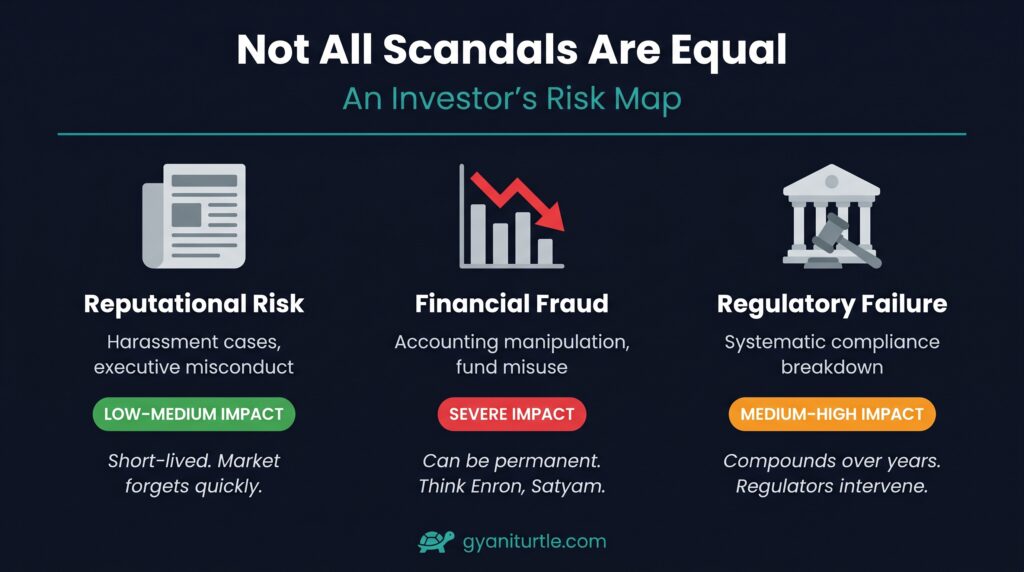
- **Wells Fargo (2016):** Fake accounts scandal. Fined $185 million. Stock dropped ~15% in the short term, recovered fully within 18 months.
- **Goldman Sachs (1MDB, 2020):** Paid $2.9 billion in settlement. Stock dipped briefly, then climbed to all-time highs.
- **JPMorgan itself (London Whale, 2012):** Lost $6.2 billion in a trading blunder. Stock fell ~25%. Within a year? Back to record highs.
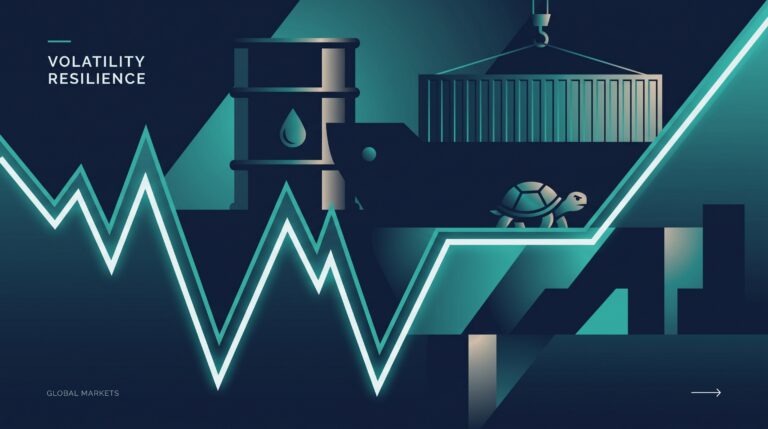
The pattern is consistent: **short-term noise, long-term fundamentals win.**
Markets care about earnings, growth, and interest rates far more than they care about internal HR scandals.
Lesson 2: Corporate Governance Is an Underrated Risk Factor
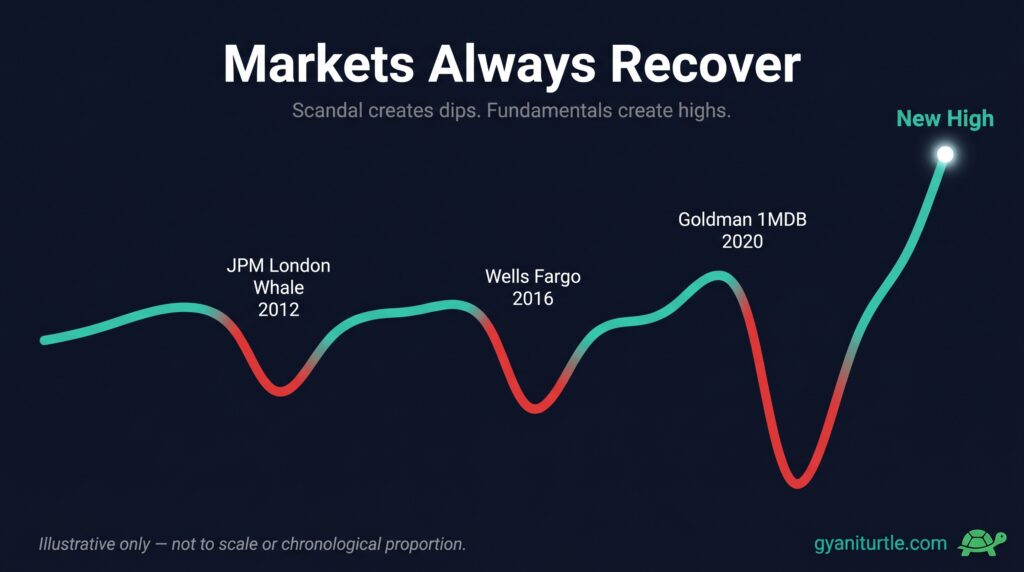
That said, not all scandals are created equal. There’s a difference between:
- Reputational scandals (harassment cases, executive misconduct) — market impact: low to medium, short-lived
- Financial fraud (accounting manipulation, fund misuse) — market impact: severe, sometimes permanent
- Regulatory failure (systematic compliance breakdown) — market impact: medium to high, can compound over years
The JPMorgan case today looks like Category 1 — an unproven civil lawsuit with reputational noise but no confirmed financial or regulatory consequence yet. It could escalate into Category 3 if regulators find systemic governance failures, but there is no evidence of that at this stage.
As a long-term investor, this is the distinction you need to train yourself to make quickly, not react emotionally to every headline.
Lesson 3: What Does This Mean for Indian Investors in US Funds?
Many Indian investors today hold international exposure through:
- US index funds via platforms like Groww or Coin (Zerodha) — such as the Motilal Oswal S&P 500 Index Fund or the Motilal Oswal Nasdaq 100 FOF. JPM is a top holding in S&P 500 funds; it is not part of tech-focused indices like FANG+, which tracks only technology companies.
- Direct US stocks via platforms like INDmoney or Vested
- Global or US banking ETFs that include JPM as a significant holding
⚠️ Practical note for Indian investors: Before investing in any international mutual fund, check whether it is currently accepting fresh lumpsum investments. SEBI periodically restricts new inflows into overseas funds when the industry-wide overseas investment limit is near its cap. This is not hypothetical — as of May 2026, the Motilal Oswal S&P 500 Index Fund is suspended for new investments on several major platforms including Groww and MySIPonline, a direct result of these industry-wide overseas caps. Always verify current status on your platform before attempting to invest.
If you hold any S&P 500 index fund, you already own JPM. It’s one of the top 10 holdings in most US large-cap indices.
Should you sell?
No. Here’s why.
Index investing means you own all the companies, not a concentrated bet on JPM’s corporate culture. One lawsuit — even a high-profile one — does not change the earnings trajectory of 500 companies. This is precisely the diversification benefit that index investing offers.
The time to worry is when a company constitutes a large chunk of a concentrated portfolio and faces financial (not just reputational) risk.
The Bigger Picture: Corporate Governance and ESG Investing
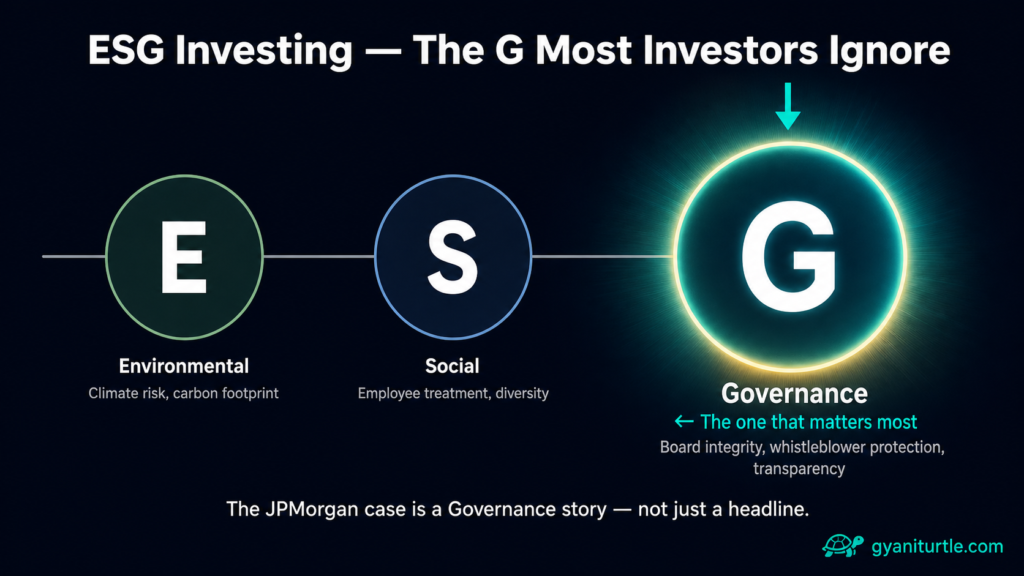
The JPM case has reignited global conversation about whistleblower protection in large financial institutions. And this ties into something Indian investors will increasingly encounter: ESG investing — Environmental, Social, and Governance criteria.
The “G” in ESG — Governance — is about exactly this. How does a company treat its employees? How transparent is its internal complaint mechanism? Does leadership tolerate misconduct to protect high performers?
SEBI has been steadily pushing Indian companies to improve governance disclosures. Many large Indian AMCs now have ESG-themed mutual funds. Understanding the “G” factor is no longer optional for a serious investor.
History shows a clear pattern — companies with weak governance controls, where leadership protects individuals over institutions, often see that rot surface as financial fraud years later. Enron, Satyam, and Yes Bank are textbook examples.
Good governance is a leading indicator. Most investors only notice when it becomes a lagging scandal.
What Should You Actually Do?
Here’s the Gyani Turtle take — practical, no noise:
- Don’t panic-sell US index fund holdings because JPMorgan is in the news. The lawsuit does not change the fund’s investment thesis.
- Monitor, don’t react. If the case escalates into regulatory action or financial penalty, re-evaluate. Until then, stick to your investment plan.
- Use this as a learning moment. The next time a stock in your direct portfolio makes headline news, ask yourself: Is this reputational, financial, or regulatory risk? That single question will save you from many bad decisions.
- Start paying attention to governance. When evaluating individual stocks — Indian or global — look at whistleblower policies, board independence, and audit committee strength. It’s boring. It also separates patient investors from reckless ones.
- Don’t take investment advice from news cycles. Markets are not Twitter. A trending lawsuit is rarely an investment signal.
The Bottom Line
PMorgan Chase is currently dealing with a serious and troubling workplace allegation. If the claims are proven true, someone in power used that power to harm another person — and then the institution may have protected itself over its employee. That deserves public scrutiny and legal accountability.
But JPMorgan the bank — the $5 trillion institution that processes millions of transactions daily, manages trillions in assets, and employs hundreds of thousands — will almost certainly survive this lawsuit.
That’s the uncomfortable truth of large-cap investing.
The company is not the same as the individuals within it. And your portfolio should not be managed based on social media outrage cycles.
Invest patiently. Analyze deeply. React rarely.
That’s the Gyani Turtle way.
Have a question about how corporate news affects your investments? Drop it in the comments below.
Disclaimer: This article is for educational purposes only and does not constitute investment advice. Please consult a SEBI-registered advisor before making investment decisions.

At Gyani Turtle, we believe every Indian deserves access to honest, jargon-free financial education. Our team simplifies investing, mutual funds, and personal finance — so you can build real wealth, one smart decision at a time. Not SEBI registered. For educational purposes only.

One Comment