
US Strategic Bitcoin Reserve: 5 Brutal Truths Every Indian Investor Must Know in 2026
In 2020, Bitcoin was called a tool for hackers.
In 2024, Wall Street wrapped it in an ETF.
(If you missed that story, here’s how the BlackRock Botcoin ETF changed everything
In 2026, the United States Treasury is HODLing it like gold.
On May 7, 2026, President Trump signed an executive order establishing the U.S. Strategic Bitcoin Reserve (SBR) — officially making Bitcoin a national security asset alongside oil, gold, and foreign currencies. The US now holds an estimated 330,000+ BTC, making it the largest sovereign Bitcoin holder on the planet.
For Indian investors, the question is not whether this matters. It clearly does.
The real question is: what do you actually do about it?
That is what this post will answer — patiently, analytically, and without the hype.
What Is the US Strategic Bitcoin Reserve — And Why Did It Happen?
Let us be precise before we react.
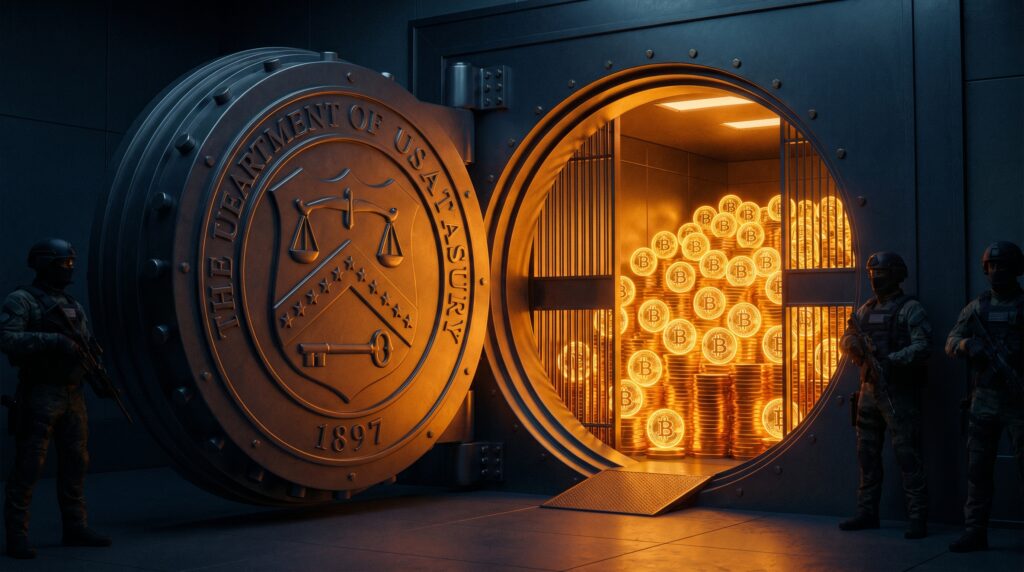
The US Strategic Bitcoin Reserve is not the government buying Bitcoin with taxpayer money on Binance. The initial holdings came primarily from forfeited crypto assets — seized by the Department of Justice and Treasury over years of enforcement actions against crypto criminals and darknet markets.
The executive order formalizes these holdings and establishes a framework for planned future acquisitions, with Bitcoin treated as a long-term strategic asset — not to be sold, borrowed against, or traded.
Why now? Three converging pressures made this inevitable:
US debt levels
The United States is carrying over $34 trillion in national debt. With the Federal Reserve undergoing a leadership transition in May 2026, the government needed a credible “hard asset” narrative to counter dollar erosion concerns. Bitcoin — with its fixed supply of 21 million coins — is the only digital asset that credibly fills that role.
Geopolitical competition.
China has been quietly accumulating gold for a decade. Nations from El Salvador to Bhutan have been accumulating Bitcoin. Washington did not want to be the last major power to recognize the shift.
Political momentum.
With a crypto-friendly administration and a Congress that passed multiple pro-digital-asset bills in 2025, the SBR was the logical culmination of years of regulatory groundwork.
The Gyani Turtle Read: This is not a speculative trade. This is sovereign legitimization. When the US Treasury treats Bitcoin as a reserve asset, every central bank in the world must now formally answer the question: should we?
The Rupee Problem: Why This Hits Different for Indian Investors

Here is where the story gets personal for anyone managing wealth in Indian rupees.
As of May 2026, the Indian Rupee is trading near ₹94 per US dollar — a level that reflects persistent inflation differentials, current account pressures, and cautious RBI policy. Over the last decade, the rupee has depreciated significantly against the dollar, quietly eroding the real purchasing power of Indian savings.
Consider the math:
Asset |
5-Year Return (approx.) |
|---|---|
Fixed Deposit (INR) |
~35% cumulative |
Gold (INR terms) |
~80% cumulative |
Bitcoin (INR terms |
~900%+ cumulative |
USD (vs INR) |
~20% appreciation |
For an Indian investor, Bitcoin is not just a tech bet. It is a USD-denominated hard asset that has historically outperformed the dollar itself. If the US Treasury now formally treats BTC as a reserve — that is the closest thing to a sovereign endorsement of Bitcoin as “digital gold.”
The comparison with gold is not accidental. India is the world’s largest gold-consuming nation— and now a new digital alternative is emerging. Here’s how India’s Electronic Gold Receipts work Indian households hold an estimated 25,000 tonnes of physical gold — a cultural hedge against currency debasement that goes back centuries. Bitcoin, with its fixed supply and increasing institutional backing, is increasingly drawing from the same psychological and economic well.
The question is not whether Bitcoin belongs in an Indian portfolio. The question is how much, in what form, and under what regulatory framework.
India’s Crypto Policy in 2026: Two Steps Forward, One Step Back
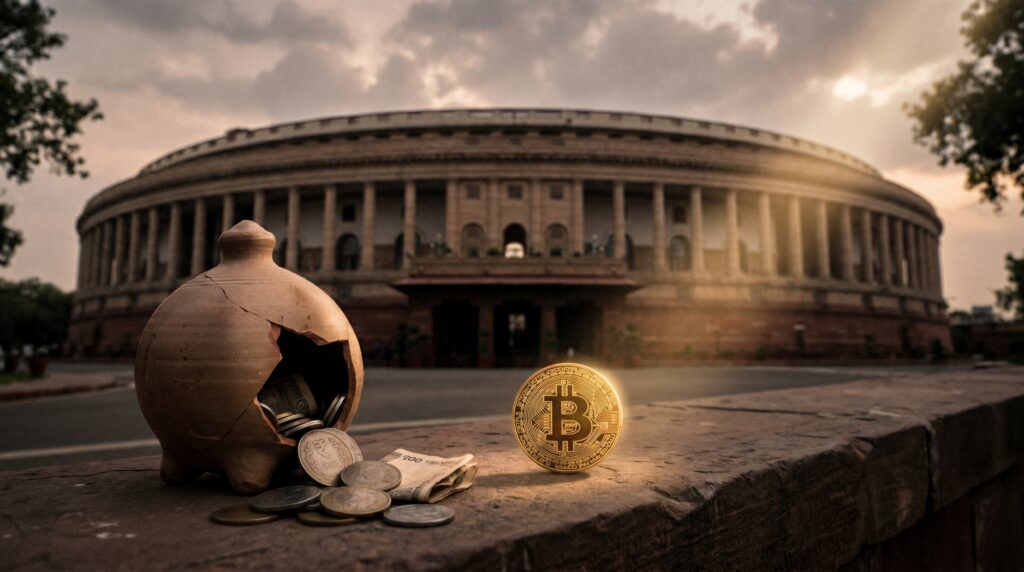
India’s relationship with crypto in 2026 is best described as: cautiously curious, punitively taxed, and deeply conflicted.
Here is where things stand as of this writing:
The positive signal:
DEA Secretary Ajay Seth recently confirmed the government is finalizing a Discussion Paper on Crypto Assets — a marked departure from the “blanket ban” rhetoric that dominated RBI communication just two years ago. In Parliament, leaders like Raghav Chadha have argued that bringing crypto onshore and regulating it properly could generate ₹15,000–₹20,000 crore in annual tax revenue that is currently being lost to offshore exchanges.
The punitive reality:
Budget 2026 introduced Section 446, which mandates a ₹50,000 flat penalty for crypto reporting errors, alongside ₹200/day for non-filing. The 31.2% effective tax rate (30% flat + 4% cess) on crypto gains — with no offset for losses across assets — remains among the highest in the world for any regulated investment class.
The global compliance layer:
The OECD’s CARF (Crypto Asset Reporting Framework) is now live in 2026, meaning offshore wallets are no longer invisible to Indian tax authorities. The era of “I’ll just hold it on a foreign exchange” is effectively over for anyone who values compliance.
Feature |
Status — May 2026 |
|---|---|
Bitcoin Price |
$77,000–$80,000 |
US BTC Holdings |
~330,000 BTC (Strategic Reserve) |
India Crypto Tax Rate |
31.2% + 1% TDS |
Section 446 Penalty |
₹50,000 flat for reporting errors |
India Sovereign BTC |
~450 BTC (vs US’s 330,000) |
Policy Discussion Paper |
Pending — expected mid-2026 |
The gap between India’s 450 BTC and America’s 330,000 BTC tells the entire story.
What the US Bitcoin Reserve Means for Global Crypto Markets
The US SBR has triggered a chain reaction that is still unfolding.
For Bitcoin’s price:
The immediate effect has been bullish. Bitcoin is currently trading between $77,000–$80,000, with institutional analysts revising year-end targets upward. When the world’s reserve currency issuer formally holds Bitcoin, it removes a category of downside risk that previously hung over the asset — the risk of a US government crackdown or ban.
For altcoins:
This is where the patient investor must be careful. The SBR is for Bitcoin specifically — not Ethereum, not Solana, not any other token. History shows that sovereign and institutional capital concentrates in the most liquid, most credible asset first. Altcoin season may follow eventually, but in a world of strategic reserves, Bitcoin and Ethereum are where capital is consolidating. The speculative long tail is getting longer and riskier.
For other nations:
The UK, Japan, and several Gulf sovereign wealth funds are reportedly in internal discussions about Bitcoin allocation. If even two or three G20 nations announce partial BTC reserves in 2026, the demand shock would be significant. India’s Discussion Paper — if it signals a constructive regulatory approach — could position the country to benefit from that wave rather than watch it from the sidelines.
The Gyani Turtle Read: Do not chase altcoins on the back of this news. This is a Bitcoin story. Capital flows to Bitcoin first, always. If you are new to crypto, that is where to start — and stop.
What Should Indian Investors Actually Do?
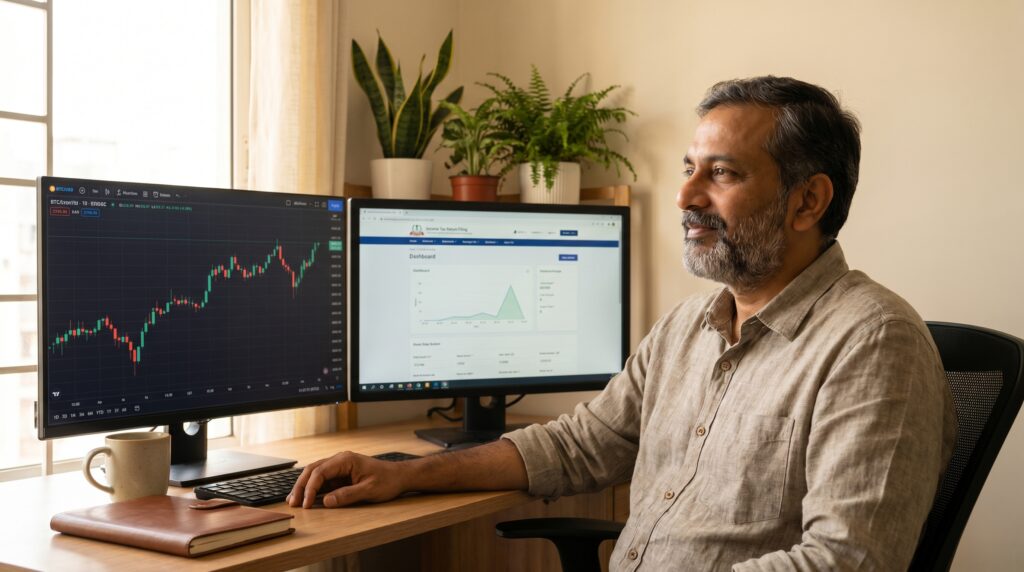
Let us be practical. Here is how a patient, analytical investor approaches this:
1. Prioritize compliance above everything else.
With CARF live and Indian tax authorities increasingly sophisticated, the cost of non-compliance now far exceeds any short-term tax saving. Use regulated Indian exchanges (CoinDCX, WazirX, Mudrex) and maintain clean transaction records. The Discussion Paper — when it arrives — is likely to reward compliant investors with better regulatory treatment.
2. Think of Bitcoin as a rupee hedge, not a get-rich-quick vehicle.
The 31.2% tax rate means you need a significant gain just to break even after tax relative to other assets. Position sizing matters. A 2–5% allocation to Bitcoin in a diversified portfolio makes structural sense as a currency hedge. A 50% allocation is a speculative bet.
3. Wait for the Discussion Paper before making large moves.
The Ministry of Finance’s crypto Discussion Paper — expected by mid-2026 — is the single most important regulatory event for Indian crypto investors this year. It may bring clearer guidance on taxation, reporting, and even reduced rates for long-term holders. Making large moves before seeing that framework is premature.
4. Focus on Bitcoin and Ethereum — ignore the noise.
In a world where sovereign capital is concentrating in Bitcoin, diversifying across 15 altcoins is not diversification — it is speculation. Two assets, properly sized, properly tracked, and properly reported.
5. Use legitimate INR-denominated routes.
For investors who want indirect exposure without the compliance complexity of direct crypto holding, US tech and blockchain ETFs available through the Motilal Oswal Nasdaq 100 FOF give you some exposure to the broader digital asset infrastructure buildout. Check current SEBI overseas investment limits before investing.
The Gyani Turtle Verdict
The US Strategic Bitcoin Reserve is a Sputnik moment for global finance.
It does not mean Bitcoin goes to $1,000,000 next month. It does not mean India will establish its own reserve tomorrow. It does not mean you should put your entire savings into crypto.
What it means is this: the debate about whether Bitcoin is a legitimate asset class is over. The US Treasury has answered that question. Every other institution — central banks, pension funds, sovereign wealth funds, and individual investors — must now answer it for themselves.
For Indian investors, the honest summary is:
- The asset has been legitimized at the highest possible level globally
- Our local tax framework remains one of the most punitive in the world
- Regulatory clarity is coming — but has not arrived yet
- The rupee depreciation argument for holding Bitcoin is structurally valid
- Position sizing and compliance are more important than timing
The patient investor does not chase the headline. The patient investor understands the structural shift, sizes appropriately, documents carefully, and waits for clarity before scaling up.
The US has made its move. India is still studying the rulebook.
That gap — between sovereign accumulation at $330,000 BTC and retail Indian investors paying 31.2% tax on every gain — is the defining crypto story of 2026.
Invest patiently. Analyse deeply. React rarely.
That’s the Gyani Turtle way. 🐢
Disclaimer: This article is for educational purposes only and does not constitute investment advice. Please consult a SEBI-registered advisor before making investment decisions.

At Gyani Turtle, we believe every Indian deserves access to honest, jargon-free financial education. Our team simplifies investing, mutual funds, and personal finance — so you can build real wealth, one smart decision at a time. Not SEBI registered. For educational purposes only.