

The NSE Electronic Gold Receipt (EGR) Handbook: How to Trade, Withdraw, and Profit from India’s New Gold Standard
India holds 25,000–30,000 tonnes of gold in households — the largest private gold stock in the world. EGRs are how that dead capital finally enters the financial system. Here’s the complete handbook.
995+ |
0% |
T+1 |
11:55 PM |
|
Minimum fineness (purity guarantee) |
GST on EGR trades (3% only on withdrawal) |
Settlement — same speed as equities |
Trading hours — tracks global gold markets |
For decades, India has been the world’s largest gold consumer — yet we’ve had zero say in how gold is priced globally. Electronic Gold Receipts change that equation. This is not just a new financial instrument. It is India’s first step toward becoming a gold price-setter.
01 — What Is an EGR?
Gold in Your Demat Account — Without Losing the Physical Option
An Electronic Gold Receipt (EGR) is a SEBI-regulated financial instrument that represents ownership of physical gold stored in a SEBI-approved vault. When you buy an EGR on the NSE, you are buying a digital title deed to real, hallmarked gold bars — not a derivative, not a fund, not a promise.
The gold backing your EGR sits in certified vaults managed by companies like Sequel Logistics. Each bar has a unique serial number and a Certificate of Purity. At any time, you can convert your EGR back into physical gold and collect it from designated centres across India.
What it is NOT |
What it IS |
|---|---|
|
Not a Gold ETF (you don’t own units of a fund) |
A direct digital title to physical gold bars |
|
Not a Sovereign Gold Bond (no govt guarantee, but no lock-in either) |
Fully liquid — buy and sell on NSE like a stock |
|
Not a gold future (no expiry, no rollover cost) |
No expiry. Hold for one day or ten years |
|
Not just paper — unlike digital gold on apps |
SEBI-regulated with physical delivery option |
Simple one-liner for your readers
An EGR is gold that lives in your demat account — trades like a stock, stores like a bank locker, and delivers like a jeweller.
02 — Why EGRs Were Created
The Problem India Was Trying to Solve
India consumes 700–900 tonnes of gold every year and privately holds an estimated 25,000–30,000 tonnes in household vaults and temple trusts. That is more gold than the combined official reserves of the US, Germany, and Italy. And almost none of it works for the Indian economy.
25,000t |
3% |
29 |
GIFT City |
|
Minimum gold held in Indian households (dead capital) |
Making charges eliminated for EGR investors vs physical jewellery |
States with different gold prices before EGRs — now one national price |
Future link to IIBX — India’s path to global price-setting |
Before EGRs, gold prices in India were set locally — the Bombay Bullion Association set one rate, different dealers quoted different premiums, and retail buyers across states paid wildly different prices for the same metal. The system was opaque, fragmented, and easy to exploit.
EGRs create what economists call a “national grid for gold” — one price, discovered transparently on the NSE screen, that becomes the benchmark for the entire country. The hidden premium jewellers charge over spot price? EGRs make that visible and eliminate it for investors.
03 — The Technical How-To
How to Actually Trade an EGR on NSE
Step 1 — Find the Right Ticker
EGRs trade in the Commodity or Debt/EGR segment on NSE. Look for:
NSE EGR Tickers |
|
1g |
NSEGOLD1 — 1 Gram EGRThe smallest tradeable unit. Best for beginners and SIP-style accumulation. Minimum investment is roughly the spot price of 1 gram. |
10g |
NSEGOLD10 — 10 Gram EGRStandard unit for most retail investors. More cost-efficient per gram due to lower transaction overhead. Equivalent to one small gold coin. |
100g |
NSEGOLD10 — 10 Gram EGRFor high-net-worth investors. Physical withdrawal at this level makes strong economic sense — you receive a certified 100g bar directly. |
Step 2 — Trading Hours (Critical Difference vs Equities)
Unlike stocks which trade 9:15 AM – 3:30 PM, EGRs follow extended hours similar to commodities — typically until 11:30 PM or 11:55 PM IST. This is deliberate: it lets Indian investors react to London (LBMA) and New York (COMEX) gold price moves during the evening session, instead of being blind to overnight moves until the next morning.
Trading window advantage
If US CPI data releases at 6:30 PM IST and gold spikes in New York, you can act on it the same evening through EGRs. Gold ETF holders have to wait until 9:15 AM the next day.
Step 3 — Order Types (Always Use Limit Orders in 2026)
You can place Market Orders (buy at current price) or Limit Orders (buy only at your specified price). Because liquidity in the EGR segment is still building in 2026, always use Limit Orders. Market orders in a thin book can result in “slippage” — buying at a price significantly higher than you intended.
Beginner Mistake to Avoid
Do not place market orders on EGRs until liquidity deepens. Set a limit price within 0.1–0.2% of the last traded price. This takes 10 seconds more and saves you from surprise fills.
04 — Physical Withdrawal
The Rematerialization Process: Taking Your Gold Home
This is EGRs’ most powerful feature — and the least understood. Here is exactly how it works, step by step.
01 |
Accumulate enough unitsTo withdraw physical gold, you need a minimum holding — typically 10g or 100g depending on the bar sizes available. Accumulate via multiple purchases over time, just like an SIP. |
02 |
Place a Rematerialization request with your DPLog into your Depository Participant (broker/demat provider — Zerodha, HDFC Securities, etc.) and submit a Rematerialization request. This converts your digital EGR holding into a physical delivery instruction. |
03 |
Receive PIN / OTP from the Vault ManagerThe Vault Manager (e.g., Sequel Logistics) sends a secure PIN/OTP to your registered mobile. This is your collection authorisation — guard it carefully. |
04 |
|
05 |
Collect from a designated Collection CentreCurrently available in Mumbai, Ahmedabad, Delhi, and other major cities. Your gold comes with a Certificate of Purity and a unique Bar Serial Number — this is certified “Good Delivery” standard gold. |
May 2026 Update — Interoperability
As of May 2026, interoperability between different Vault Managers has improved significantly. You can now buy an EGR backed by a Kolkata vault and, for a small logistics fee, arrange pickup from a collection centre in a different city. India’s gold market is now effectively borderless for EGR holders.

05 — EGR vs The Alternatives
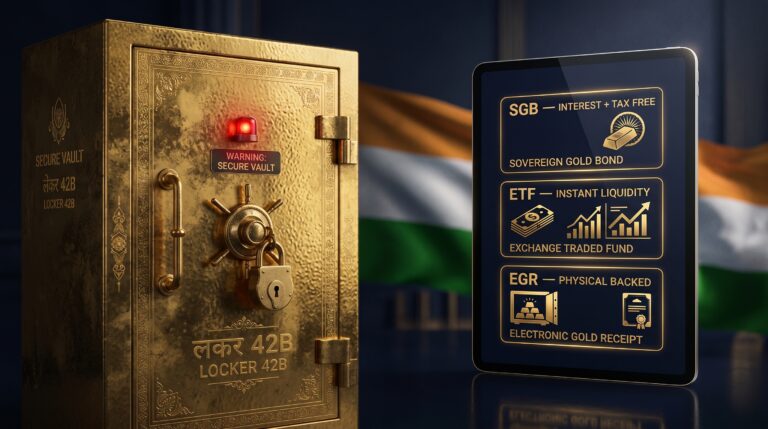
How EGRs Stack Up Against Every Other Way to Own Gold
Feature |
EGR (NSE) |
Gold ETF |
Sovereign Gold Bond |
Physical Jewellery |
|---|---|---|---|---|
|
Physical delivery |
✓ Yes |
✗ No |
✗ No |
✓ Already physical |
|
Making charges |
✓ None |
✓ None |
✓ None |
✗ 8–25% added |
|
Lock-in period |
✓ None |
✓ None |
✗ 5–8 years |
✓ None |
|
Interest income |
✗ None |
✗ None |
✓ 2.5% p.a. |
✗ None |
|
GST on trade |
✓ 0% |
✓ 0% |
✓ 0% |
✗ 3% + making |
|
Extended trading hours |
✓ Until 11:55 PM |
✗ Market hours only |
✗ Market hours only |
✗ No |
|
SEBI regulated |
✓ Yes |
✓ Yes |
✓ RBI regulated |
✗ BIS only |
|
Purity guaranteed |
✓ 995/999 fineness |
✓ Yes (fund holds) |
✓ RBI backed |
⚠ Varies by jeweller |
Bottom line
SGBs win if you want interest income and are happy with an 8-year horizon. EGRs win if you want the physical delivery option, flexibility, and real-time pricing — without jewellery’s hidden costs.
06 — The Data Specs
Everything in One Place: EGR Technical Facts
Data Point |
Detail (2026) |
|---|---|
|
Minimum Purity |
995 Fineness (standard) / 999 Fineness (premium) |
|
GST on Trading |
0% |
|
GST on Physical Withdrawal |
3% (at collection point only) |
|
Settlement Cycle |
T+1 (funds and securities) |
|
Regulator |
SEBI (Securities and Exchange Board of India) |
|
Depository |
NSDL / CDSL (same as equities) |
|
Trading Hours |
Typically until 11:30 PM – 11:55 PM IST |
|
Available Denominations |
1g, 10g, 100g (varies by broker) |
|
Vault Managers (2026) |
Sequel Logistics and other SEBI-approved vaults |
|
Making Charges |
Eliminated for investors |
|
Wastage Charges |
Eliminated for investors |
|
Bar Serial Number |
Provided at withdrawal — “Good Delivery” standard |
|
Certificate of Purity |
Issued with every physical withdrawal |
|
Interoperability (May 2026) |
Cross-city pickup now available for small logistics fee |

07 — The Big Picture
Why EGRs Matter for India’s Economy, Not Just Your Portfolio
Most investing articles stop at “here’s how to trade it.” This section explains why EGRs are a macro-level event for India — and why understanding it makes you a better investor.
1. A National Price Grid for Gold
Before EGRs, gold prices varied state by state, set by local associations with no transparency. The NSE EGR price now becomes the national benchmark — one transparent, exchange-discovered price that every jeweller, bank, and investor references. The “hidden premium” retailers charged over international spot prices is now visible and squeezed out.
2. Financialisation of 25,000 Tonnes of Dead Capital
India’s household gold doesn’t move, doesn’t earn, and doesn’t contribute to economic growth. By moving gold into the EGR system, it becomes a liquid financial asset. Banks can accept EGRs as loan collateral more easily than physical bars. Businesses can use gold holdings to raise working capital. The velocity of money in the Indian economy increases — without printing a single rupee.
3. India as a Global Gold Price-Setter
Currently, global gold prices are set in London (LBMA) and New York (COMEX). India, the world’s largest consumer, has zero influence on these prices. The long-term plan is to sync EGRs with the India International Bullion Exchange (IIBX) in GIFT City — allowing Indian buyers’ demand to directly affect global spot prices. We move from price-taker to price-maker.
The GIFT City Connection
IIBX in GIFT City already handles imports for nominated agencies. As EGR volumes grow on NSE and the two exchanges integrate, India’s gold market will have global price discovery for the first time in history. For long-term investors, this is the macro bet embedded in EGRs.
08 — How to Get Started
Step-by-Step for First-Time EGR Buyers
01 |
Check if your broker supports the EGR segmentNot all brokers have activated the EGR segment. Check with Zerodha, HDFC Securities, ICICI Direct, or Kotak Securities — most have enabled it by 2026. You need a demat account, not a separate commodity account. |
02 |
Search for NSEGOLD1 or NSEGOLD10In your trading platform, switch to the Commodity / EGR segment and search for the ticker. If you don’t see it, enable the segment in your account settings or call your broker’s helpdesk. |
03 |
Always place a Limit OrderSet your buy price within 0.1–0.2% of the last traded price. This protects you from slippage in a market where liquidity is still growing. Never use Market Order until EGR volumes mature. |
04 |
Start with NSEGOLD1 — accumulate in SIP styleBuy 1–2 grams a month consistently. EGRs have no minimum holding period and no lock-in. Treat it like a gold SIP — small, regular, and automatic. Once you hit 10g, you have the physical withdrawal option if needed. |
05 |
Decide: Hold digitally or withdraw physicallyMost investors never need to withdraw physically. But if you want gold for jewellery, gifting, or a wedding, the rematerialisation route saves you making charges and wastage — potentially 10–25% compared to buying from a jeweller. |
The Gyani Turtle Take
Five Principles for Investing in EGRs the Right Way
EGRs are one of the most structurally sound new instruments SEBI has introduced in years. But like any financial product, they reward discipline and punish impulsiveness.
The Gyani Turtle EGR FrameworkFive Principles for Getting EGRs Right |
|
01 |
Use EGRs for allocation, not speculation.Gold belongs in a portfolio as a hedge against inflation and currency risk — not as a trading vehicle. 5–10% allocation in gold is the standard across most financial planning frameworks. |
02 |
Always use Limit Orders until liquidity deepens.The EGR segment is still building its order book in 2026. Slippage on a market order can cost you more than an entire year’s storage fee. |
03 |
Plan your withdrawal decision before you buy.If you need physical gold within 2 years (for a wedding, for example), start buying EGRs now. The GST savings and zero making charges vs a jeweller make EGRs the smarter path to physical gold. |
04 |
Track the IIBX-NSE integration story.As India’s domestic and international gold markets connect, EGR prices will gradually align with global benchmarks. Early holders benefit most from this price convergence. |
05 |
Don’t confuse EGRs with digital gold apps.Paytm Gold, PhonePe Gold, and similar products are not SEBI-regulated and carry counterparty risk. EGRs are exchange-traded, vault-backed, and deposited in your official demat account. |
Gold has been India’s store of value for 5,000 years. EGRs are how it enters the next 50. Invest patiently. Analyse deeply. React rarely. That’s the Gyani Turtle way.
Disclaimer: This article is for educational purposes only and does not constitute investment advice. Please consult a SEBI-registered advisor before making investment decisions.

At Gyani Turtle, we believe every Indian deserves access to honest, jargon-free financial education. Our team simplifies investing, mutual funds, and personal finance — so you can build real wealth, one smart decision at a time. Not SEBI registered. For educational purposes only.



One Comment