How to Buy EGR in India: The Smart Way to Own Gold in 2026
PM Modi has asked India to stop buying physical gold. Oil is at $126 a barrel. The Rupee is bleeding. But here is the question nobody is answering loudly enough: if not physical gold, then what? The answer landed quietly on May 4, 2026, when NSE launched its Electronic Gold Receipt segment — and if you still don’t know how to buy EGR (Electronic Gold Receipt) in India, you are already behind.
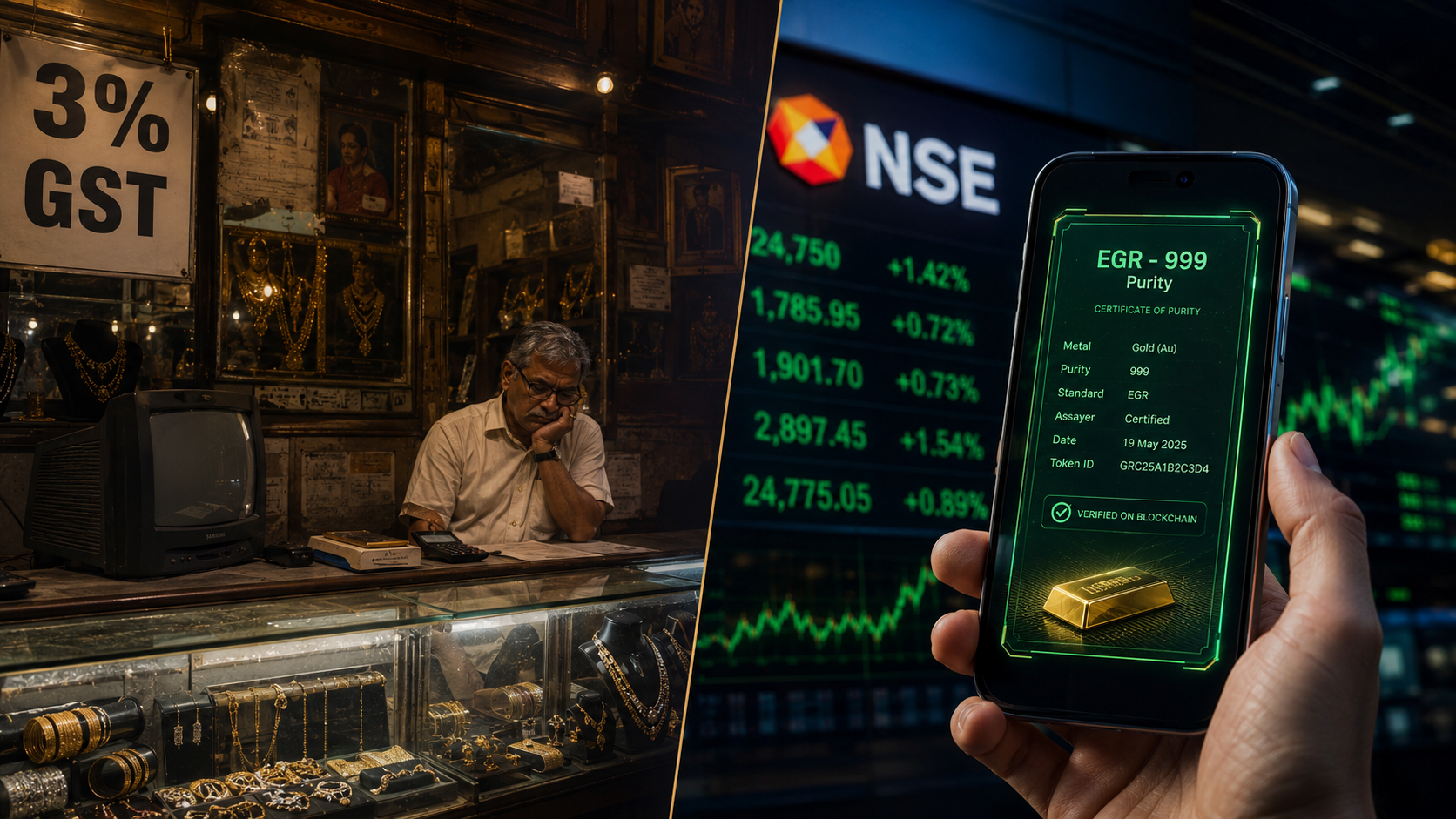
This is not another paper gold gimmick. An Electronic Gold Receipt is 100% backed by real, physical 999-purity gold sitting in a SEBI-regulated vault. You pay zero GST when you buy. Your LTCG clock starts at just 12 months instead of 24. And converting your existing physical gold into an Electronic Gold Receipt attracts zero capital gains tax. In a crisis where every gram of imported gold is a bullet fired at the Rupee, EGRs are the answer that protects your wealth without harming your nation. Here is everything you need to know.
The 30-Second Sip: The NSE launched Electronic Gold Receipts (EGRs) on May 4, 2026 — and it changes everything about how Indians should buy gold. EGRs are 100% backed by physical gold held in SEBI-approved vaults. You pay zero GST when you buy. The LTCG holding period is just 12 months (vs 24 months for physical gold). And converting physical gold to EGR — or back — attracts zero capital gains tax. In a crisis where PM Modi is begging Indians to stop buying physical gold, EGRs are the answer nobody is talking about loudly enough.
The Strait of Hormuz is choked. Crude oil is burning at $126 a barrel. The Rupee is under sustained pressure. And PM Modi has made an unprecedented public appeal:
“The country must prioritise economic stability over luxury spending. I urge every Indian family: avoid buying or gifting physical gold for one year — even for weddings.”
But here is the question every practical Indian investor is sitting with:
“I understand the patriotism argument. But I still need to protect my wealth. Gold has always been my hedge. What do I do?”
The answer arrived quietly on May 4, 2026, when NSE launched its Electronic Gold Receipt segment — bringing mainstream retail access to arguably the most powerful gold investment instrument India has ever seen.
This is your complete guide to understanding, buying, and maximising EGRs in 2026.
What Exactly Is an EGR (Electronic Gold Receipt)?
An Electronic Gold Receipt is exactly what the name says — a digital receipt for real, physical gold.
Here is how it works:
- A gold depositor (a refiner, jeweller, or individual) deposits 999 purity physical gold with a SEBI-regulated Vault Manager
- The Vault Manager issues an EGR — a digital receipt representing that gold — into the depositor’s Demat account
- That EGR is then traded on NSE or BSE just like a stock, in real time
- At any point, the EGR holder can surrender the receipt and take physical delivery of the gold from the vault — paying 3% GST only at that point of withdrawal
The critical distinction: when you buy an Electronic Gold Receipt on the exchange, no new gold is imported into India. You are simply trading ownership of gold that already exists in a SEBI-approved Indian vault. Zero dollar outflow. Zero forex pressure on the Rupee.
This is why EGRs are not just a smarter personal investment — they are an act of economic responsibility in the current crisis.
The Verified Facts Every EGR Buyer Needs to Know
|
Data Point |
Value |
Source |
Status |
|---|---|---|---|
|
NSE EGR Launch Date |
May 4, 2026 |
NSE Circulars |
✅ Confirmed |
|
Minimum Investment Denomination |
100 milligrams (mg) |
BSE/NSE Product Specs |
✅ Confirmed |
|
Trading Hours |
Mon–Fri, 9:00 AM to 11:30/11:55 PM |
SEBI Framework / Anand Rathi |
✅ Confirmed |
|
GST on EGR Trading |
0% on purchase |
Finnovate / SEBI Guidelines |
✅ Confirmed |
|
GST on Physical Withdrawal |
3% (paid only when you take delivery) |
SEBI / GST Council |
✅ Confirmed |
|
LTCG Holding Period |
12 months (vs 24 months for physical gold) |
Income Tax Act / ClearTax |
✅ Confirmed |
|
LTCG Tax Rate |
12.5% |
Income Tax Act |
✅ Confirmed |
|
Conversion Tax (Physical ↔ EGR) |
Zero under Section 47(viid) |
Income Tax Act / Finnovate |
✅ Confirmed |
|
Vault Manager Minimum Net Worth |
₹50 crore |
SEBI Regulation |
✅ Confirmed |
|
Settlement |
T+1 on NSE/BSE |
Exchange specs |
✅ Confirmed |
One number worth pausing on: The LTCG holding period for EGRs is 12 months — half the 24-month period required for physical gold to qualify for the same 12.5% LTCG rate. If you sell physical gold at the 18-month mark, you pay tax at your full income slab rate (up to 30%). The same sale via EGR at 18 months? LTCG at 12.5%. That difference alone can save a significant amount of tax for any serious investor.
The Vicious Cycle — And How EGRs Break It
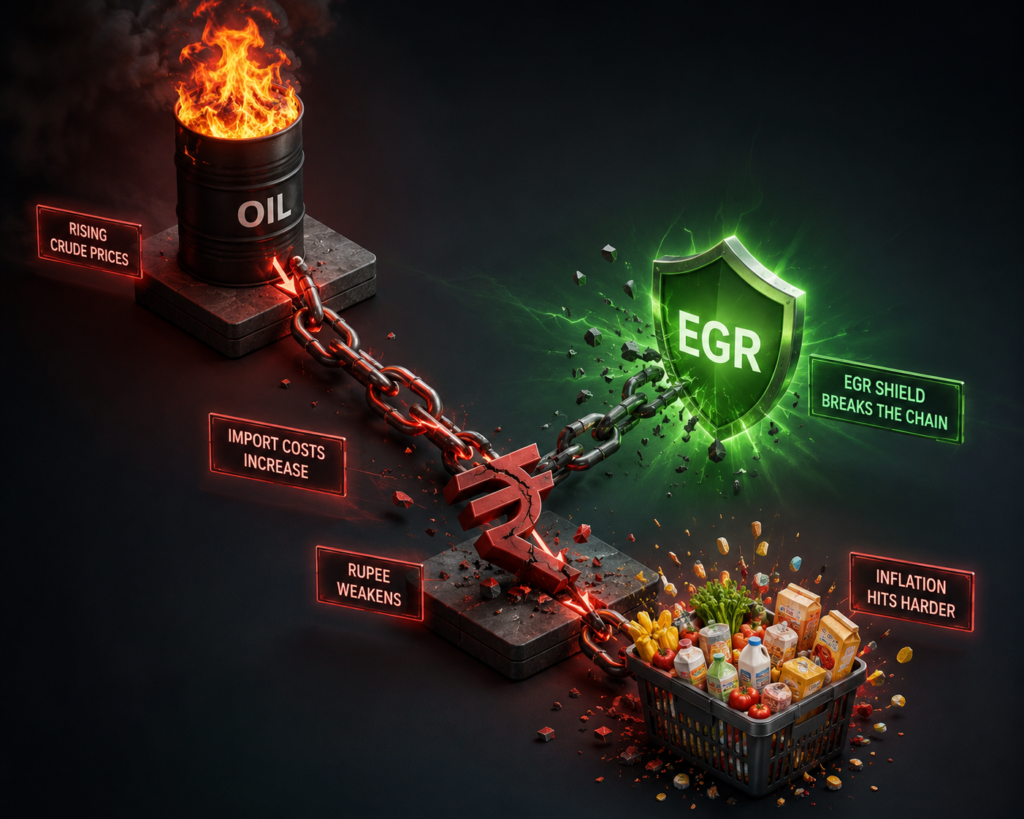
Understanding why EGRs matter requires understanding the chain reaction that physical gold buying triggers:
Step 1 — The Macro Shock: Strait of Hormuz crisis sends crude oil to $126/barrel.
Step 2 — The Dollar Drain: India pays for expensive oil in US Dollars, draining forex reserves.
Step 3 — The Retail Mistake: Panicked by inflation, families rush to jewellers. India imports almost all its gold — adding billions more in dollar outflows on top of the oil bill.
Step 4 — The Rupee Collapse: The double whammy of $126 oil and heavy gold imports crushes the Rupee to record lows against the USD.
Step 5 — Imported Inflation: A weak Rupee makes everything India imports more expensive — electronics, fertilisers, medicines, and logistics.
Step 6 — The Middle-Class Trap: The RBI hikes rates to fight inflation. Vegetable prices soar. Home loan EMIs jump by ₹5,000–8,000 per month. The gold bought for “safety” just destroyed the monthly household budget.
Step 7 — The EGR Circuit Breaker: An EGR (Electronic Gold Receipt) purchase routes money into the Indian demat ecosystem using gold that is already in Indian vaults. Zero new gold is imported. Zero additional dollar pressure on the Rupee. Your wealth is protected — without harming the economy that pays your salary.
The Sharma Family: Physical Gold vs EGR — Two Futures
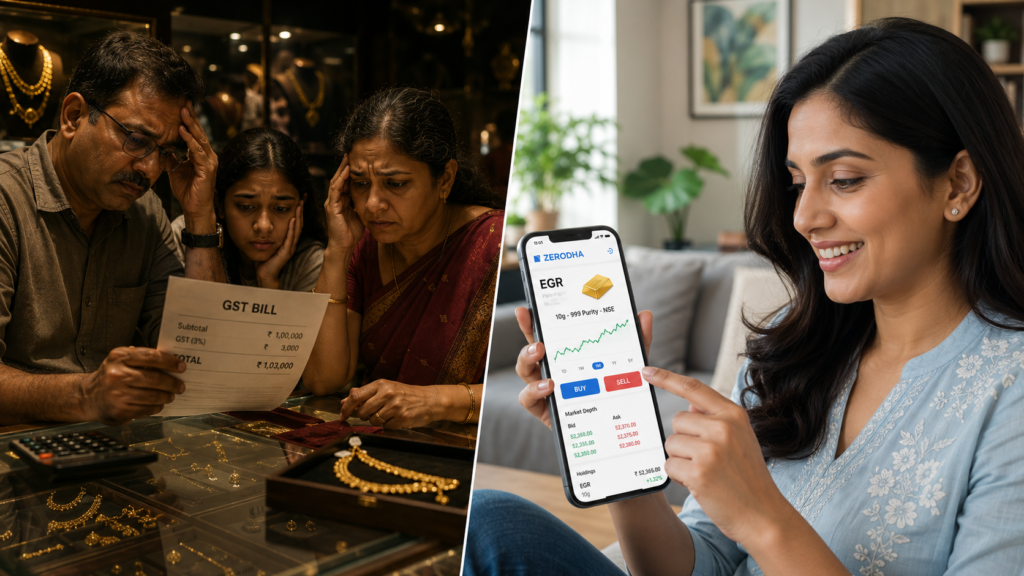
The Sharma family of Bengaluru. Combined income: ₹2.2 lakh/month. Goal: Invest ₹3 lakh in gold for their teenage daughter’s future.
❌ The Wrong Choice — The Traditional Trap
Mr. Sharma visits a jeweller and buys physical gold coins worth ₹3 lakh.
- Upfront GST: ₹9,000 (3%) — lost immediately
- Annual locker rental: ₹3,000/year
- If sold at 18 months: Treated as Short-Term Capital Gain — taxed at his 30% income slab rate
- National impact: His purchase directly drains India’s forex reserves during a currency crisis
What happens next: The Rupee weakens further. Inflation climbs. The RBI hikes rates. Mr. Sharma’s home loan EMI rises by ₹6,000/month. The gold in the locker earns zero. His “safety net” helped trigger the inflation that is now strangling his cash flow.
✅ The Right Choice — The EGR (Electronic Gold Receipt) Way
Mrs. Sharma opens her Zerodha app and buys ₹3 lakh worth of EGRs in 10-gram denominations on the NSE.
- GST on purchase: ₹0
- Locker rental: ₹0 (gold held in SEBI vault)
- If sold at 13 months: Qualifies for 12.5% LTCG (holding period met at 12 months)
- Tax saving vs physical gold: ₹52,500+ on a ₹3 lakh investment if sold between 12–24 months
- National impact: Zero dollar outflow. The money stays in the Indian financial ecosystem.
- Bonus: If she wants physical gold for the wedding eventually, she can surrender the EGR, pay 3% GST at that point, and take delivery of 999 purity physical gold from the vault
That is not a compromise. That is a strictly better deal on every dimension.
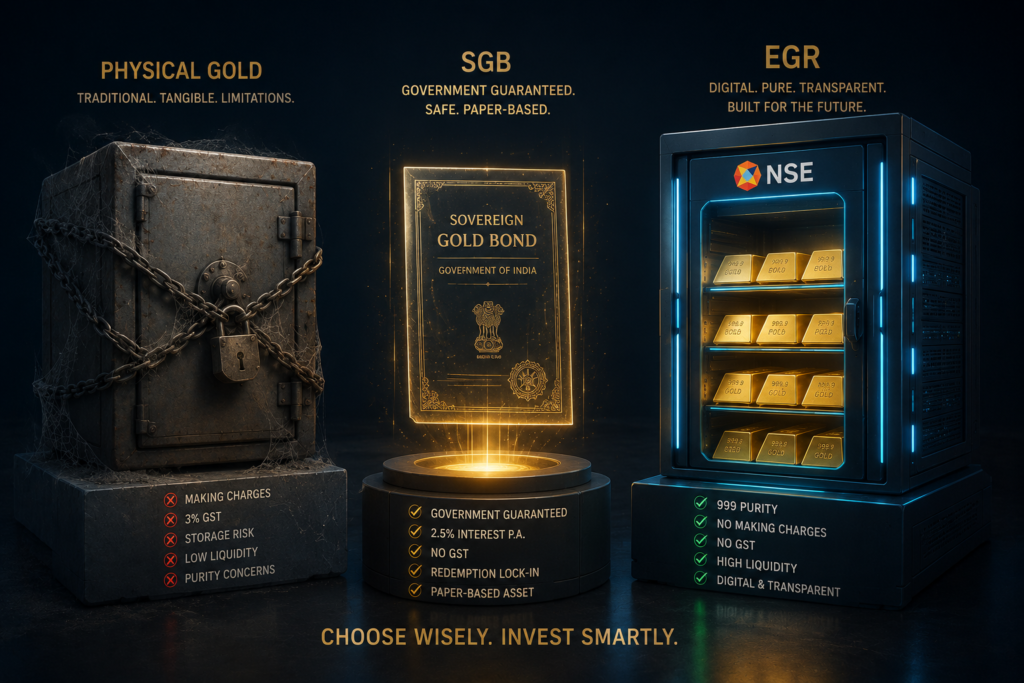
Electronic Gold Receipt vs The Competition: The Complete Comparison
|
Instrument |
Form |
National Impact |
Liquidity |
LTCG Holding Period |
GST |
Supports India? |
|---|---|---|---|---|---|---|
|
EGR |
Demat (100% physical-backed) |
Positive — uses vaulted gold |
High (T+1, NSE/BSE) |
12 months at 12.5% |
0% on trade; 3% only on withdrawal |
✅ Yes |
|
Physical Gold |
Coins / Jewellery / Bars |
Catastrophic — drains Forex |
Low |
24 months at 12.5% |
3% upfront + making charges |
❌ No |
|
Sovereign Gold Bond |
Digital Debt Instrument |
Excellent — zero Forex drain |
Very Low (illiquid) |
Exempt if held to maturity |
None |
✅ Yes |
|
Gold ETF |
Digital Fund Unit |
Neutral |
Very High |
12 months at 12.5% |
None (no physical withdrawal) |
✅ Yes |
Reading the table:
- EGR beats physical gold on tax efficiency, GST, liquidity, and national impact
- EGR beats Gold ETF on one critical dimension: you can actually convert it to physical gold if you ever need it
- SGB still wins on tax (zero capital gains at maturity) but loses badly on liquidity — you are locked in for 8 years
- EGR is the bridge — the liquidity of an ETF, the physical backing of a coin, and a tax profile significantly better than jewellery
How to Actually Buy an EGR — Step by Step
Buying an EGR (Electronic Gold Receipt) is simpler than most people expect. If you can buy a stock, you can buy an EGR.
Step 1 — Ensure your broker supports EGR trading
As of May 2026, major brokers including Zerodha, ICICI Direct, and Anand Rathi support the EGR segment. Some discount brokers are still enabling this — check your app’s trading segments.
Step 2 — Open the EGR segment on your broker platform
Navigate to the commodity or EGR section of your broker app. Search for EGR contracts on NSE or BSE.
Step 3 — Choose your denomination
EGRs are available in denominations starting from 100 milligrams — making them accessible even for small investors. Common denominations: 1 gram, 2 grams, 5 grams, 10 grams.
Step 4 — Place your order
Buy during trading hours (Monday to Friday, 9:00 AM to 11:30 PM / 11:55 PM). The EGR will settle in your Demat account on T+1 basis.
Step 5 — Hold, sell, or withdraw
- To sell: Simply place a sell order on the exchange — same as selling a stock
- To withdraw physical gold: Submit a withdrawal request through your broker. Pay 3% GST at this point. The Vault Manager arranges delivery of 999 purity gold
Step 6 — Track your tax position
Hold for at least 12 months to qualify for 12.5% LTCG. If you convert physical gold to EGR (Electronic Gold Receipt) (or vice versa), note that this is not treated as a taxable transfer under Section 47(viid) — zero capital gains tax at the time of conversion.
What the Institutions Are Saying
NSE on the EGR launch: Sriram Krishnan, Chief Business Development Officer at NSE, stated at the May 4 launch: “With this launch, NSE aims to create a robust and transparent ecosystem for gold trading, enabling efficient price discovery and enhanced trust across stakeholders including jewellers, refiners, traders, and institutional investors.”
SEBI: Regulates the entire EGR (Electronic Gold Receipt) ecosystem. Has mandated that Vault Managers maintain a minimum net worth of ₹50 crore and allow full interoperability — you can deposit gold with one vault manager and withdraw from another. This prevents monopolistic pricing and protects investors.
Income Tax Department: Specifically inserted Section 47(viid) into the Income Tax Act confirming that converting physical gold into an EGR — or converting an EGR back into physical gold — is not considered a transfer, and thus attracts zero capital gains tax at the moment of conversion.
BSE: First launched the EGR segment in 2022. NSE’s May 2026 launch brings significantly larger retail liquidity and mainstream broker participation to the market.
The Honest Risks: What the Skeptics Say
At Gyani Turtle, we never oversell. Here is what Electronic Gold Receipt critics correctly point out:
The Liquidity Gap:
Electronic Gold Receipt trading volumes on NSE/BSE are still building. Unlike Gold ETFs which trade millions of units daily, EGR markets may have wider bid-ask spreads in the early months — meaning you might pay slightly more when buying or receive slightly less when selling compared to the theoretical gold price.
Vault Storage Charges:
EGRs are not completely free to hold. Vault Managers deduct periodic storage fees from holdings. These are small but real — factor them into your total cost of ownership, especially for longer holding periods.
Broker Availability:
As of May 2026, not all major discount brokers have fully enabled EGR trading on their platforms. If your preferred broker does not yet support EGRs, you may need to open an additional account or wait for the rollout.
Not a Replacement for SGBs:
If your investment horizon is 8+ years and you have no need for liquidity, SGBs still offer the best tax outcome — zero capital gains tax at maturity plus 2.5% annual interest. EGRs are superior for medium-term investors who want flexibility.
What You Should Actually Do

For salaried individuals:
Stop the monthly physical gold coin habit. Open your Zerodha or ICICI Direct app, enable the EGR segment, and begin accumulating EGRs in 1-gram or 2-gram denominations. You save 3% GST upfront, pay zero locker fees, and get a more favourable LTCG period. Same gold exposure. Strictly better economics.
For families with upcoming weddings:
Buy EGRs in the bride’s name now. Hold for 12+ months. When the wedding approaches, decide then whether to take physical delivery (pay 3% GST at that point) or keep as a digital asset. You defer the GST, earn any price appreciation, and keep your options open — all while supporting the Rupee.
For business owners and MSMEs:
EGRs are excellent for short-term corporate treasury management. If your business holds idle cash as a rupee hedge, EGRs give you gold price exposure with T+1 liquidity — far more accessible than physical gold, which is hard to liquidate quickly when you need working capital.
For investors with a portfolio view:
Use EGRs as the liquid gold layer of your portfolio. Pair with SGBs for the 8-year, tax-free layer. Together they give you full gold exposure with both liquidity and tax efficiency — without importing a single gram of physical gold.
The Gyani Turtle Verdict
The Electronic Gold Receipt is not a gimmick. It is a structurally superior instrument for anyone who wants gold exposure in 2026 — better tax treatment, zero GST on purchase, full physical backing, real exchange liquidity, and zero pressure on India’s forex reserves.
At a time when PM Modi is appealing for a national pause on physical gold buying — and when that appeal is backed by $126 oil, a $333 billion trade deficit, and falling forex reserves — EGRs are not just the smart investor’s choice. They are the responsible citizen’s choice.
You do not have to choose between protecting your wealth and protecting the Rupee.
With EGRs, you do both.
Invest patiently. Analyse deeply. React rarely.
That’s the Gyani Turtle way. 🐢
Try Our Free Calculators
- Planning Retirement ? Calculate your FIRE number : FIRE Number Calculator
- Don’t miss SIP, find out how much you can worth with just a small amount : SIP Calculator
- Finding ways to end your EMI’s, calculate and visualize here : EMI Calculator
Disclaimer: This article is for educational purposes only and does not constitute investment advice. Please consult a SEBI-registered advisor before making investment decisions.

At Gyani Turtle, we believe every Indian deserves access to honest, jargon-free financial education. Our team simplifies investing, mutual funds, and personal finance — so you can build real wealth, one smart decision at a time. Not SEBI registered. For educational purposes only.