
India Data Center Tax Holiday Budget 2026: The 21-Year Boom Explained
The India data center tax holiday Budget 2026 is not a minor fiscal footnote. It is a 21-year legislative guarantee — written directly into the Finance Act — designed to redirect hundreds of billions of dollars of global cloud and AI infrastructure capital onto Indian soil.
This is the most significant single policy intervention for India’s digital infrastructure since broadband liberalisation. And unlike a ministerial order that can be reversed overnight, this one requires a full Act of Parliament to undo.
This article breaks down exactly what the policy says, why India needed it, how the money flows from Parliament to the real economy, and what it means for salaried professionals, business owners, retail investors, and NRIs.
If you are new to understanding how Indian budget policies translate into economic shifts, start with our guide on [How Budget Policy Changes Affect Indian Investors] before reading further.
India Data Center Tax Holiday Budget 2026: What the Policy Actually Says
On February 1, 2026, Finance Minister Smt. Nirmala Sitharaman announced the framework in her Union Budget Address to Parliament:
“Recognising the need to enable critical infrastructure and boost investment in data centres, I propose to provide tax holiday till 2047 to any foreign company that provides cloud services to customers globally by using data centre services from India. It will, however, need to provide services to Indian customers through an Indian reseller entity.” — Smt. Nirmala Sitharaman, Union Budget Address to Parliament, February 1, 2026.
Three provisions form the structural core of this framework.
Provision 1 — The 21-Year Fiscal Runway. Eligible foreign cloud service providers pay zero corporate income tax in India on qualifying global revenue from Tax Year 2026–27 until March 31, 2047. The exemption is codified in the Finance Act Gazette — not a ministerial order — meaning it requires a full Parliamentary legislative process to reverse. (Source: Press Information Bureau / Finance Act Gazette, March 30, 2026)
Provision 2 — Safe Harbor Threshold Overhaul. The safe harbor transaction ceiling for IT and IT-enabled Services (ITeS) has been raised from ₹300 crore to ₹2,000 crore. This single change eliminates the transfer pricing litigation risk that historically deterred global enterprises from scaling Indian operations. (Source: MeitY Ministerial Briefing, February 2026)
Provision 3 — Related-Party Transfer Pricing Guardrail. A fixed 15% safe harbor margin on costs has been introduced for transactions where a domestic data center operates as a related cost-plus center for a foreign parent entity — removing the “arm’s length” ambiguity that historically produced 5–7 year legal disputes under OECD frameworks. (Source: Union Budget 2026-27 Legislative Provisions, February 1, 2026)
Conflict of interest disclosure: Adani Group and Reliance Industries are referenced in this article as publicly announced corporate participants in India’s data center sector. Gyani Turtle holds no financial position in any named company. All references are strictly for macroeconomic illustration and do not constitute a buy, sell, or hold recommendation.
Why India Needed This: The Data Paradox
Before the India data center tax holiday Budget 2026 was announced, India faced a structural anomaly staggering in scale.
India historically generated approximately 20% of the entire planet’s raw digital data — yet processed or stored over 95% of it outside its own borders, predominantly in Singapore, the United States, and parts of Europe. (Source: JM Financial Services Research Ecosystem Assessment, February 2026)
The result: Indian businesses were paying dollar-denominated fees to foreign servers to process Indian data, exposing operating margins to rupee depreciation while contributing nothing to domestic compute infrastructure, domestic employment in advanced engineering, or Indian tax revenues.
A country generating one-fifth of the world’s data had almost no sovereign compute capacity to show for it. This paradox is exactly what the 21-year tax holiday is legislatively designed to reverse.
India Data Center Tax Holiday Budget 2026: The Global Context
The India data center tax holiday Budget 2026 did not arrive in isolation. It landed precisely as global demand for compute infrastructure reached a structural inflection point.
Across 2025, data center assets commanded more than 20% of the total value of all global greenfield infrastructure projects announced worldwide — an absolute figure exceeding $270 billion. (Source: UNCTAD Annual Report, late 2025)
India’s position at the end of 2025 relative to that wave:
- Operational data center power capacity: 1.5 Gigawatts (GW) across seven primary metropolitan clusters (confirmed)
- Projected capacity target by end of 2026: 1.7 GW (projected)
- Active investments under construction or operational: approximately $70 billion (confirmed)
- Fresh long-term corporate commitments announced: approximately $90 billion (confirmed announcements; execution timelines projected)
(Source: MeitY Statement at India AI Summit, 2026 · JM Financial, February 2026)
Shri Ashwini Vaishnaw, Union Minister for Electronics and Information Technology, framed the strategic rationale directly:
“Data centres, particularly AI data centres, play a critical role in the infrastructure layer of the AI architecture. This tax holiday till 2047 provides the multi-decade policy visibility and long-term tax certainty that global hyperscalers require to anchor their core global infrastructure blocks on Indian soil.” — Shri Ashwini Vaishnaw, PIB Media Briefing, February 1, 2026.
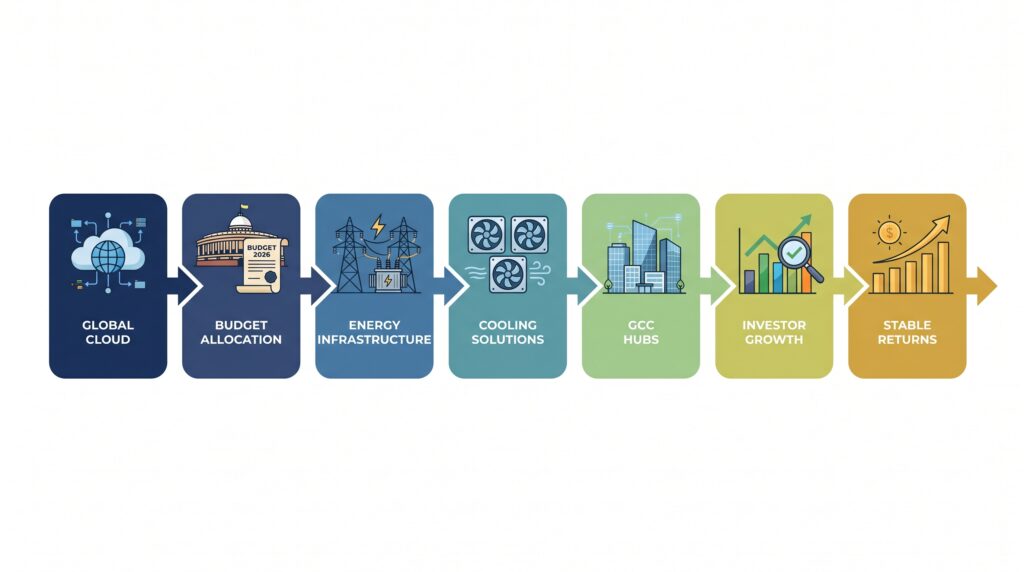
How India Data Center Tax Holiday Budget 2026 Flows Through the Economy: The 7-Step Chain
Understanding the India data center tax holiday Budget 2026 means tracing how a policy codified in New Delhi structurally alters corporate decision-making in Silicon Valley, Singapore, and Seattle — and where value ultimately accumulates domestically.
Step 1 — The Global AI Compute Deficit
Worldwide enterprise adoption of AI and cloud architectures has created an unprecedented global shortfall in hyperscale data center capacity and high-performance GPU clusters. Demand is structurally outpacing available supply across every major global hub.
Step 2 — The Legislative Catalyst
The Finance Act 2026 codifies 0% corporate tax on qualifying global cloud revenue routed through Indian data centers until 2047. Crucially, it explicitly shields foreign companies from Permanent Establishment (PE) tax nexus risks on non-India-sourced revenue — the single legal ambiguity that had historically kept global hyperscalers from anchoring core infrastructure in India.
Step 3 — Hyperscaler Capital Reallocation
Global technology infrastructure leaders rapidly adjust multi-billion-dollar long-term capex frameworks, pivoting away from high-cost, space-constrained hubs like Singapore toward India. Puneet Chandok, President of Microsoft India and South Asia, described the shift as moving the conversation “from short-term fiscal trade-offs to multi-decade asset creation.” (Industry Response Commentary, February 2026)
Step 4 — Local Joint-Venture Execution
Global hyperscalers enter long-term co-location and infrastructure agreements with dominant Indian infrastructure conglomerates and specialised data center developers. (Disclosure: Adani Group has publicly announced a $100 billion roadmap for green-powered, AI-ready data centers by 2035. Reliance Industries has announced a $120 billion digital-AI infrastructure commitment. Both are projected corporate targets with no guaranteed delivery timeline.)
Step 5 — State-Level Competition Multiplier
Maharashtra, Tamil Nadu, and Telangana compete aggressively for these mega-projects by layering localised incentives on top of the central tax holiday: stamp duty waivers on land acquisition, electricity duty exemptions, and fast-tracked heavy green-power transmission lines.
Step 6 — The Corporate and Startup Surge
Local Global Capability Centers (GCCs), IT services firms, and early-stage startups witness an abrupt reduction in local cloud latency and compute costs. DD Mishra, Vice President Analyst at Gartner, observed that raising the safe harbor ceiling to ₹2,000 crore effectively shifts India’s value proposition — from a low-cost software outsourcing destination into a stable, dispute-free environment capable of hosting mission-critical global AI and R&D workloads. (Strategic Market Assessment, February 2026)
Step 7 — The Ancillary Industrial Multiplier
Increased domestic industrial demand creates revenue expansion opportunities across the supporting value chain: heavy electrical switchgear manufacturers, industrial liquid-cooling system providers, commercial real estate developers with existing land banks near power substations, and green energy utilities supplying the grid.
Two Paths Through the India Data Center Tax Holiday Budget 2026 Era
This is an illustrative scenario for educational purposes only. Not investment advice.
Consider two households navigating the Budget 2026 announcement with ₹15,00,000 in liquid capital earmarked for a 3–5 year horizon.
Path A — The Speculative Land Trap
Rajesh acts on an unverified tip from online investment groups. He uses the entire ₹15,00,000 as a downpayment on a speculative, illiquid agricultural plot 65 km outside Hyderabad — betting a global data center developer will purchase it from him. He funds the remainder with a ₹30,00,000 bank loan at 9.5% annual interest.
Meanwhile, his wife Priya keeps her B2B logistics analytics startup anchored to offshore servers in Singapore at $800 per month, exposing their household operating margins to rupee depreciation.
After 3 years: The data center consortium purchases land inside an official government-notified IT zone with pre-built power substations — not Rajesh’s plot. The agricultural plot remains completely illiquid with no secondary buyer. Bank loan interest alone drains ₹8,55,000 from the household budget over the period. Net result: severe cash crunch, zero capital appreciation, and ongoing currency-exposed operating costs for Priya’s business.
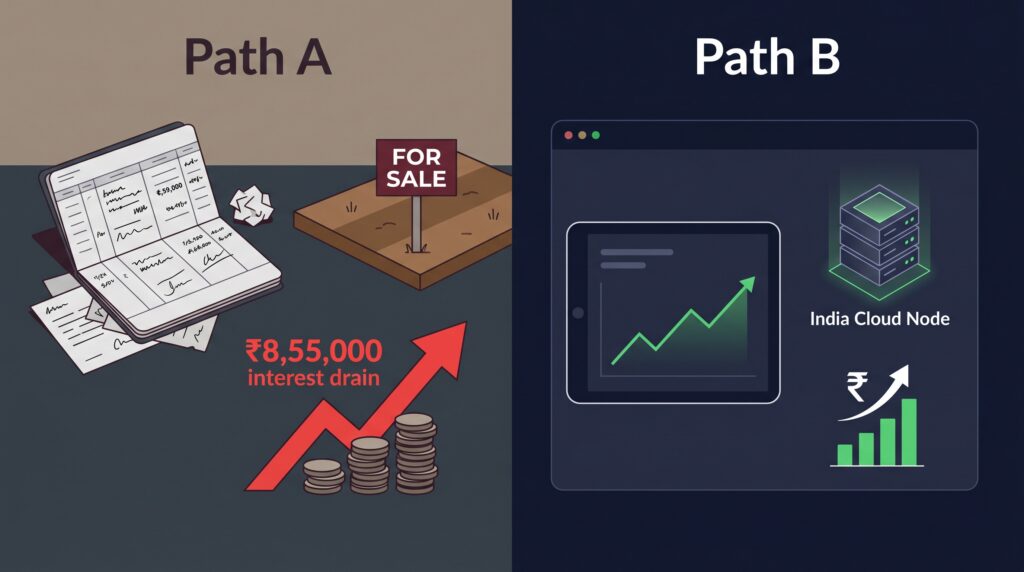
Path B — The Structural Ecosystem Approach
Instead of speculation, Rajesh spreads the ₹15,00,000 across liquid, publicly listed ecosystem enablers: 40% in green utility stocks supplying the national grid, 30% in industrial cooling and electrical equipment manufacturers, and 30% in a diversified infrastructure-focused mutual fund.
Priya simultaneously migrates her startup’s computing workloads to an India-based data center via a local authorised reseller — cutting monthly compute costs from $800 (dollar-denominated, Singapore) to approximately ₹35,000, saving roughly ₹3,15,000 annually and eliminating currency risk from her ledger.
After 3 years: The structural ecosystem portfolio grows at an annualised rate of 14.5%, reaching approximately ₹22,50,000 from the original ₹15,00,000 base. (This is a backtested historical simulation — not a guaranteed return. Actual market returns will vary based on fund selection, entry timing, and market conditions.)
The differential: ₹6,60,000 in portfolio value and ₹3,15,000 annually in operating savings — from a single strategic decision.
Policy Comparison: India Data Center Tax Holiday Budget 2026 vs Global Frameworks
|
Feature |
India — Budget 2026 Stack |
Ireland |
Singapore |
OECD Standard |
|---|---|---|---|---|
|
Tax on qualifying global cloud revenue |
0% until March 31, 2047 |
12.5% standard corporate rate |
10–17% with selective bespoke concessions |
Varies by jurisdiction |
|
Transfer pricing certainty |
Fixed 15% safe harbor margin on costs |
Arm’s length OECD testing — frequently litigated |
Selective bespoke arrangements |
Arm’s length — 5–7 year dispute timelines common |
|
IT safe harbor ceiling |
₹2,000 crore |
No direct equivalent |
No direct equivalent |
No equivalent |
|
Legislative durability |
Statutory Finance Act — requires Parliamentary reversal |
Standard corporate rate — budget-adjustable |
Administrative — modifiable |
Policy-dependent |
|
Environmental resource intensity |
High — 150B liters water in 2025; scaling toward 2% of national grid |
Low — ambient northern temperatures reduce cooling load |
Moderate |
Varies |
|
Supports India’s growth? |
Yes — anchors sovereign compute capacity domestically |
Partially |
Partially |
N/A |
What India Data Center Tax Holiday Budget 2026 Means for You: Audience-Specific Guidance

Salaried Professionals
If you work in enterprise technology, cloud architecture, power engineering, or industrial HVAC systems, the demand curve is localising rapidly. Up-skilling in high-density power management, AI compute architecture, or data center infrastructure management aligns directly with the corporate hiring trajectory now taking shape across Hyderabad, Mumbai, Pune, and Chennai.
For portfolio exposure, financial planners often suggest reviewing whether your existing equity mutual funds carry structural weightings in heavy electrical equipment, grid transmission, and power generation — the physical backbone of every data center.
Business Owners and MSMEs
If your business relies on heavy data processing, machine learning, or software-as-a-service delivery, the India data center tax holiday Budget 2026 framework structurally changes your compute cost economics. Migrating legacy offshore database workloads to India-based data center nodes via authorised local resellers can reduce latency, eliminate currency risk from your operating cost base, and improve margins before your next funding round.
B2B suppliers and light manufacturers can also explore vendor onboarding with major data center developers. The sector requires sustained large-volume supplies of everything from heavy cabling and precision metal server racks to specialised physical security systems and large-scale facility management services.
Retail Investors
Experienced investors frequently avoid the most visible headline stocks following a major policy announcement — these may already reflect steep premium valuations. Instead, they study the less-glamorous, indispensable sub-sectors: publicly listed manufacturers of industrial liquid-cooling systems, power transformers, backup diesel and gas generators, and specialised engineering and construction firms with existing data center project portfolios.
Diversified theme-based ETFs or mutual funds tracking the broader manufacturing, infrastructure, and energy utility sectors offer exposure to this structural shift without the risk of single-stock concentration. Consider linking to our guide on [Large Cap vs Mid Cap vs Small Cap Mutual Funds] to understand which fund tier historically captures industrial infrastructure themes most efficiently.
NRIs and Global Indians
NRIs are statutorily restricted from directly investing in certain categories of agricultural land — which structurally protects them from the speculative traps outlined in Path A. The optimal entry point to capture the India data center tax holiday Budget 2026 opportunity remains entirely liquid: routing capital via NRE (Non-Resident External) or NRO (Non-Resident Ordinary) accounts into listed equities, thematic infrastructure mutual funds, or commercial Real Estate Investment Trusts (REITs) with data center and industrial asset exposure.
Under existing Double Taxation Avoidance Agreements (DTAA) between India and major global nations — including the United States, United Kingdom, and GCC states — capital gains on Indian listed securities are calculated and settled cleanly at source. Capital deployed via NRE accounts remains fully and freely repatriable in foreign currency, making liquid infrastructure vehicles an effective tool for global portfolios seeking India’s long-term digital infrastructure growth story. For more on liquid investment vehicles for NRIs, see our [Complete Guide to Electronic Gold Receipts (EGRs)].
Families and Homemakers
The single most important guidance here: avoid committing family capital to speculative residential or agricultural real estate plays based purely on “nearby data center” rumours circulating in local WhatsApp groups or tip forums. These industrial complexes are highly secure, self-contained operational zones requiring dedicated power substations, water management systems, and controlled-access perimeters. They rarely stimulate local consumer retail footfall, residential demand, or walkable commercial activity in their immediate surroundings. The land they buy is pre-planned, pre-powered, and selected years before public announcements.
The Honest Counterargument: Where India Data Center Tax Holiday Budget 2026 Could Go Wrong
The Domestic Critique — Resource Depletion and Tax Revenue Loss
Domestic environmental economists and civic policy advocates argue that data centers are utility-intensive operations yielding relatively low direct employment per square foot of footprint. India’s data centers consumed approximately 150 billion liters of water in 2025 for evaporative cooling systems alone — a figure modelled to surge to 358 billion liters by 2030 under current trajectory assumptions. (Source: Environmental Impact Baseline Assessments, February 2026. The 2030 figure is a projection, not a confirmed outcome.)
In a geography that regularly manages seasonal heatwaves, urban water stress in Tier-1 cities, and power grid instability in Tier-2 corridors, allocating priority transmission lines and regional water tables to cool servers processing global, non-India-sourced data risks building significant domestic public and political pushback.
Critics further argue that 21-year tax holidays strip the public exchequer of direct corporate income tax collections from some of the wealthiest technology monopolies on earth — a subsidy whose beneficiaries are overwhelmingly foreign shareholders, not Indian retail investors or working households.
The Global Critique — The AI Proof-of-Value Risk
Global technology analysts warn of a looming macro risk: a structural compute capacity oversupply. If global enterprise organisations struggle to monetise their massive artificial intelligence investments by late 2026 or 2027, the market could face an abrupt pullback in hyperscaler capital budgets.
If global cloud giants unexpectedly slow or cancel Indian rollouts due to an international technology investment cooling cycle, India risks over-building highly capital-intensive, specialised power and cooling infrastructure. This could leave domestic real estate partners and state-level utility providers holding heavily underutilised industrial assets with payback periods stretching well into the 2030s.
What India’s Institutions Are Doing
Ministry of Finance formally reframed cloud infrastructure as critical national infrastructure in Budget 2026-27, recognising high-performance compute capacity as the foundational manufacturing layer of the digital economy — equivalent in national strategic importance to physical port and highway infrastructure.
MeitY explicitly linked the data center incentives to the newly funded India Semiconductor Mission (ISM) 2.0 and the expanded Electronics Components Manufacturing Scheme (ECMS). The stated policy objective is a vertically integrated domestic technology stack — from physical silicon manufacturing at the chip level all the way up to localised sovereign cloud hosting.
Gartner observes that the elevation of the safe harbor ceiling to ₹2,000 crore shifts India’s institutional value proposition — from a low-cost software outsourcing hub into a stable, dispute-free environment capable of hosting mission-critical global AI and platform engineering workloads.
Global investment bank consensus acknowledges the unmatched fiscal visibility of the 21-year tax holiday while consistently cautioning that real-world capacity execution will ultimately be gated by the speed and stability of India’s utility grids — specifically the ability to deliver 24/7 firm green renewable power to support hyperscale cooling loads at scale.
The Bottom Line: India Data Center Tax Holiday Budget 2026
The India data center tax holiday Budget 2026 is a generational infrastructure bet written into statute.
The $160 billion active and pipeline investment figure, the 21-year tax certainty, the safe harbor threshold overhaul, and the seven-step industrial multiplier chain all point toward a structural, decade-long shift — not a cyclical trade.
The data paradox — India generating 20% of global data while processing 95% of it offshore — is the exact structural gap this policy is legislatively designed to close.
Whether you are a salaried professional aligning your skills with the new demand curve, an MSME migrating compute workloads to reduce currency exposure, a retail investor studying the ancillary industrial value chain with patience, or an NRI routing capital through liquid infrastructure vehicles — the strategic question is not whether this shift is happening.
The question is how structurally and patiently you are positioned for it.
Invest patiently. Analyse deeply. React rarely. That is the Gyani Turtle way. 🐢
Use Our Calculators:
- Calculate your retirement according to your lifestyle and saving habits using our calculator: Fire Calculator – Plan your retirement
- Know how much you pay in taxes and compare which regime is better : Tax Calculator- New V/S Old
- Calculate your home loan EMI using our Advanced EMI Pay Early calculator – EMI Calculator
This article is for educational purposes only. All projected figures are clearly marked and do not constitute investment advice or a guarantee of future performance. Gyani Turtle is not a SEBI-registered Investment Adviser. No part of this analysis constitutes a buy, sell, or hold recommendation for any specific equity, derivative, REIT, or corporate instrument. All named companies are referenced for macroeconomic illustration only. Please consult independent SEBI-registered financial advisors and legal professionals before making any investment or cross-border asset allocation decisions.

At Gyani Turtle, we believe every Indian deserves access to honest, jargon-free financial education. Our team simplifies investing, mutual funds, and personal finance — so you can build real wealth, one smart decision at a time. Not SEBI registered. For educational purposes only.