Starship V3 Shows Why SpaceX Is No Longer Just a Rocket Company
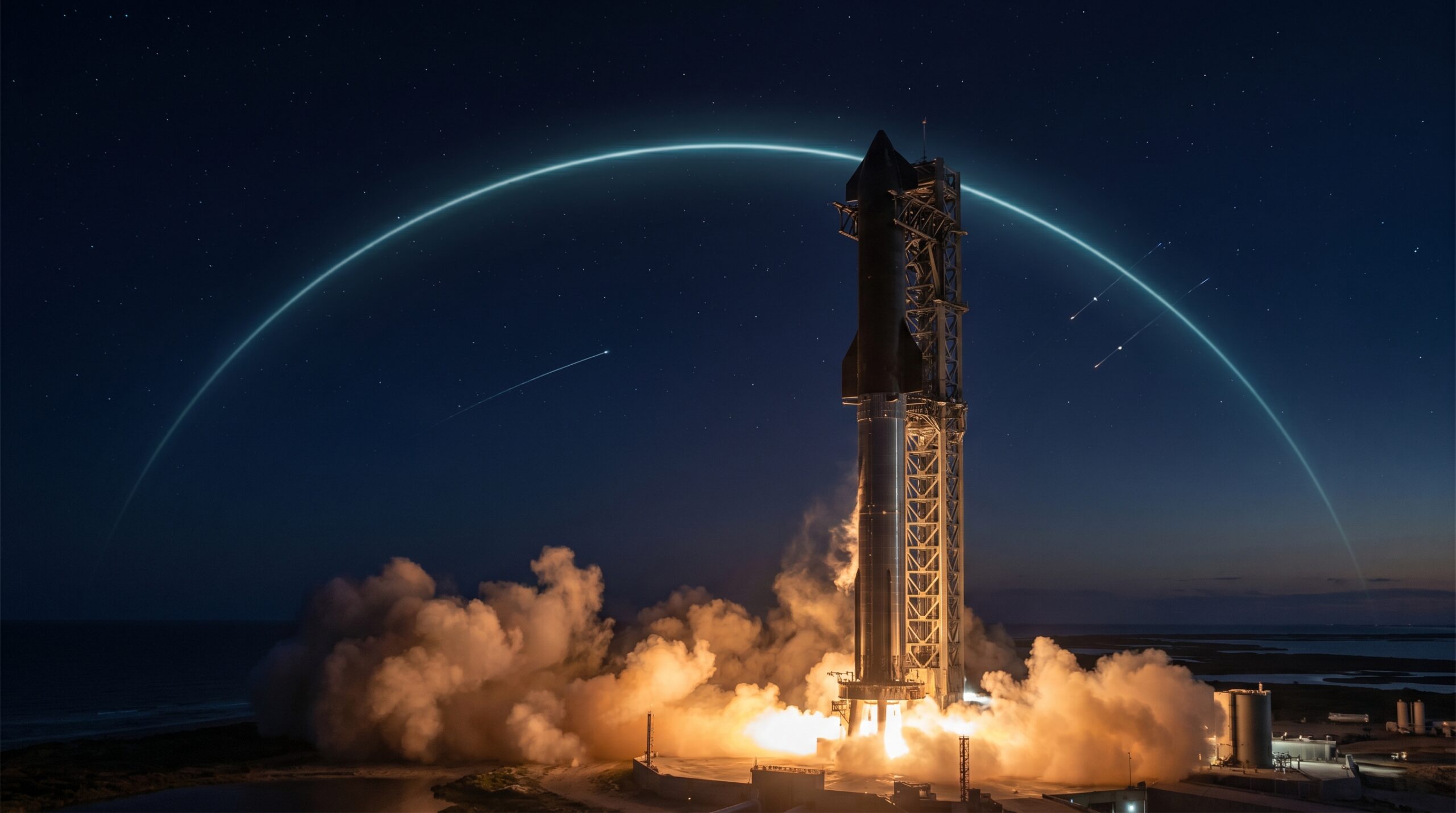
Starship V3 is the engineering story behind SpaceX’s trillion-dollar valuation debate. SpaceX’s IPO story may be written in dollars, but its real test is being written in fire, steel, engines, and regulatory paperwork.
That is why Starship V3 matters for investors.
The upgraded Starship V3 system is not just another rocket milestone. It is the hardware layer behind the entire SpaceX valuation argument. If Starship V3 becomes reliable, reusable, and frequent, SpaceX can scale Starlink, launch defense constellations, support lunar and Mars ambitions, and potentially build the logistics foundation for future orbital infrastructure.
If Starship struggles, the IPO story becomes much harder to justify.
The Numbers That Define This Moment
|
Data Point |
Reported Detail |
Investor Meaning |
Status |
|---|---|---|---|
|
Vehicle generation |
Starship V3 |
Next major design step for SpaceX’s heavy-lift system |
Reported |
|
Engine architecture |
Raptor 3 |
Higher-performance engine family central to reuse economics |
Reported |
|
Vehicle scale |
Around 400-foot class |
Largest and most powerful rocket system ever flown |
Reported |
|
Flight 12 upper stage |
Planned Indian Ocean splashdown |
Shows progress on stage objectives |
Reported |
|
Booster result |
Recovery/soft landing objective missed |
Keeps full-reuse economics unproven |
Reported |
|
FAA response |
Mishap review / temporary grounding |
Regulatory cadence remains an investor variable |
Reported |
Note: Starship test details can change as FAA, SpaceX, and launch observers release updated information. Investors should verify official SpaceX and FAA updates before treating any single test as final proof.
Why Starship V3 Matters to the Business
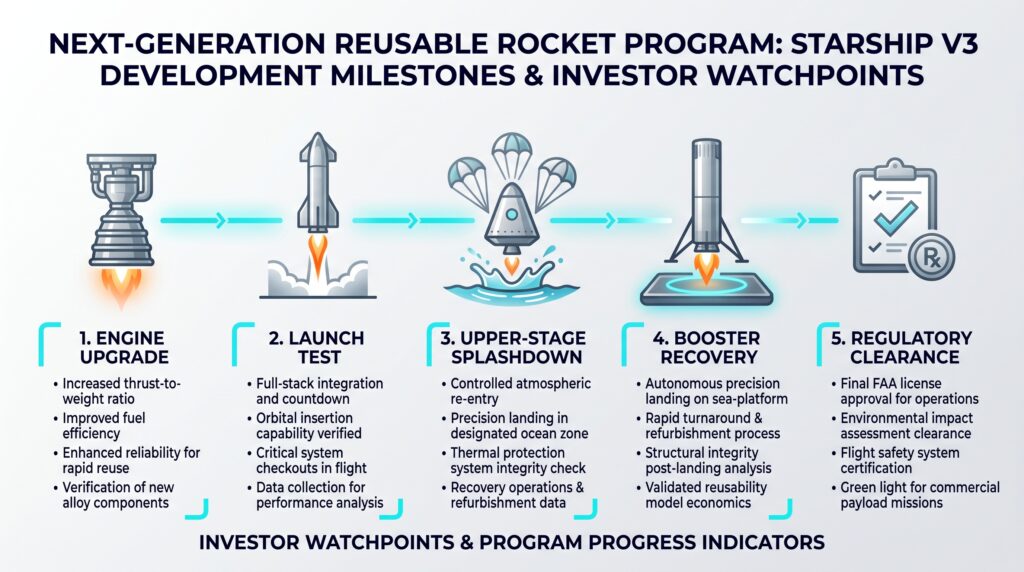
Falcon 9 made SpaceX commercially credible. Starship V3 is supposed to help make SpaceX economically dominant.
Falcon 9 proved that reusable rockets could work in the real world. Starship is designed to push that model much further by carrying far more mass to orbit and eventually returning both stages for reuse. The business logic is simple: if SpaceX can launch more payload at lower cost, it gains a structural advantage across nearly every business line.
Starlink needs constant satellite deployment and replacement. Defense constellations need speed, scale, and resilience. Future lunar missions need heavy-lift capacity. Mars ambitions need a vehicle that can be refueled and reused. AI infrastructure dreams, if they ever move meaningfully into orbit, would require enormous logistics capacity.
That is why Starship V3 is not a side project. It is the transportation layer for SpaceX’s most valuable ambitions.
The Flight 12 Signal: Progress, But Not Perfection
The Starship V3 debut appears to have delivered the kind of mixed result that defines SpaceX’s development culture.
The upper stage reportedly completed key objectives and ended with a planned fiery splashdown in the Indian Ocean. That is meaningful progress. SpaceX does not need every early test to look like a polished airline launch. It needs data, design validation, and proof that each vehicle generation is moving closer to operational use.
But the booster issue matters.
The Super Heavy booster reportedly failed to complete the intended soft ocean landing objective, which led the FAA to classify the event as a mishap and temporarily ground the system pending review. That does not destroy the Starship thesis. But it does delay the cleanest version of the bull case: full, rapid, reliable reuse.
For investors, the difference between “big rocket that flies” and “fully reusable transport system” is enormous.
What Global Investors Should Watch
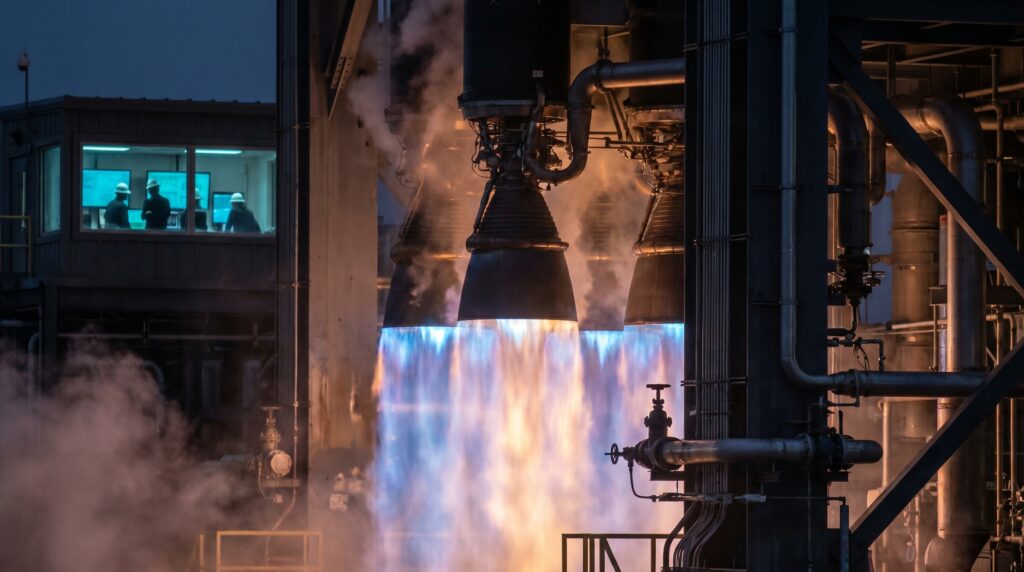
For US investors, Starship is directly tied to SpaceX’s national security and commercial launch dominance. A reliable Starship gives the US a heavy-lift capability that no other private company can easily match. That supports both market power and strategic importance.
For European investors, Starship affects the competitive landscape for Arianespace, European defense-space planning, and access to launch capacity. If SpaceX continues reducing launch costs, European space programs may face pressure to either partner more deeply or accelerate their own reusable systems.
For Indian and Asian investors, Starship matters because it shapes the cost of satellite deployment, broadband expansion, and global space infrastructure. Even investors who never buy SpaceX directly may be exposed through telecom, defense, satellite, semiconductor, and global technology funds.
The key metrics to watch are:
- Time between test flights.
- Booster recovery progress.
- Raptor 3 reliability.
- Payload deployment capacity.
- FAA investigation timelines.
- Evidence that Starship lowers actual Starlink deployment costs.
The FAA Grounding Is Not Noise
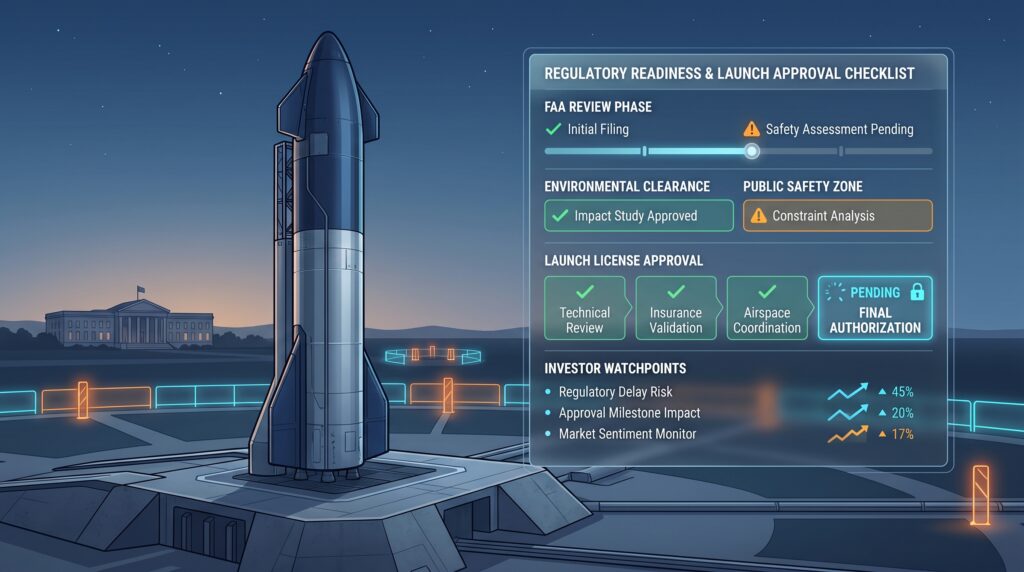
SpaceX is famous for moving fast. But rocket development does not move only at engineering speed. It also moves at regulatory speed.
The FAA’s job is not to protect SpaceX’s IPO narrative. It is to evaluate public safety, environmental impact, mishap causes, corrective actions, and launch-license compliance. Every grounding, review, and corrective-action requirement can affect test cadence.
Investors should avoid two mistakes.
The first mistake is treating every mishap as a disaster. Test programs fail, especially when they are pushing new hardware.
The second mistake is treating every mishap as irrelevant. If Starship cannot fly frequently, the cost curve does not improve fast enough. If regulators require lengthy reviews after each problem, SpaceX’s development cycle slows. If the booster remains hard to recover, the full-reuse economics remain theoretical.
Regulatory friction is not fatal, but it is part of the valuation.
The Contrarian View: Starship May Take Longer Than the Market Wants
The bull case assumes Starship moves quickly from test vehicle to commercial workhorse.
The contrarian case says the market may be underestimating how hard that transition is.
Building the world’s most powerful rocket is one problem. Flying it repeatedly is another. Recovering it safely is another. Refurbishing it cheaply is another. Launching it often enough to change unit economics is another. Doing all of that under regulatory scrutiny is the hardest version of the challenge.
SpaceX has solved difficult engineering problems before, so betting against the company has historically been dangerous. But public investors buying at a trillion-dollar-plus valuation are not betting on “eventually.” They are betting on Starship V3 timing, scale, and execution discipline.
If Starship takes five extra years to mature, that may still be a historic engineering success. It may also be a disappointing investment outcome for IPO buyers who paid for rapid transformation.
From Rocket Company to Infrastructure Company
The most important shift in SpaceX’s identity is that the company can no longer be described with one label.
It is an aerospace company.
It is a satellite broadband operator.
It is a defense contractor.
It is a launch logistics platform.
It may also become an AI infrastructure company if the xAI and orbital compute ambitions become central to the business.
Starship ties those pieces together. Cheaper launch supports Starlink. Starlink supports recurring revenue. Defense contracts support strategic demand. AI infrastructure creates a new reason to build even more orbital capacity. Each piece strengthens the others if execution holds.
That is the flywheel investors are being asked to believe in.
The risk is that one weak link slows the entire system.
Data Verification
|
Claim |
Current Reading |
Reliability |
|---|---|---|
|
Starship V3 represents a major next-generation upgrade |
Supported by launch reporting |
Medium-high |
|
Raptor 3 is central to the V3 architecture |
Supported by launch and technical reporting |
Medium-high |
|
Upper stage achieved planned splashdown |
Reported by space coverage |
Medium-high |
|
Booster missed soft landing objective |
Reported by space and FAA-related coverage |
Medium-high |
|
FAA temporarily grounded Starship after the mishap |
Reported by Space.com and aviation/space outlets |
Medium-high |
|
Starship will quickly make launch costs collapse |
Not yet proven |
Low-medium |
The Gyani Turtle Take
Starship V3 is the engineering proof point behind the SpaceX IPO story.
If the rocket matures, SpaceX becomes more than a launch company. It becomes a logistics backbone for satellites, defense networks, lunar missions, and possibly orbital compute. That is the kind of infrastructure position investors pay premium valuations for.
But investors should track milestones, not spectacle.
The next launches matter less for viral video and more for cadence, booster recovery, payload deployment, engine reliability, and regulatory closure. A rocket that looks impressive is not enough. A rocket that flies often, recovers cleanly, and lowers real costs is what supports the valuation.
Starship V3 keeps the dream alive. It does not finish the investment case.
Sources consulted: External references for this analysis include Space.com coverage of Starship V3 and FAA review, Phys.org/AP coverage of the Starship test flight, Flying Magazine coverage of Starship Flight 12, Next Spaceflight launch tracking.
Also Read:
- SpaceX’s Trillion-Dollar IPO: Opportunity, Hype, and the Risks Investors Can’t Ignore
- Beyond Rockets: How Defense Contracts and Bitcoin Could Shape SpaceX’s Financial Future 2026
- How to Use Agentic AI in Investment and Trading — A Complete Guide for Indian Investors
Disclaimer: This article is for educational and informational purposes only and does not constitute investment advice, financial advice, or a recommendation to buy or sell any security. SpaceX remains subject to technical, regulatory, financial, and execution risks. Consult official company filings and qualified financial professionals before making investment decisions.

At Gyani Turtle, we believe every Indian deserves access to honest, jargon-free financial education. Our team simplifies investing, mutual funds, and personal finance — so you can build real wealth, one smart decision at a time. Not SEBI registered. For educational purposes only.