Is Your SIP Nifty IT Safe? 5 Truths About AI and India’s IT Stocks in 2026
It is one of the most widely held stocks in Indian portfolios — in direct equity, in index funds, in large-cap mutual funds, and in retirement accounts across the country. For millions of Indian families, TCS is not just a ticker on a screen. It is a symbol of India’s rise as a global technology power.
So here is the question nobody in your WhatsApp investment group is asking directly:
What happens to that Nifty IT holding if artificial intelligence systematically removes the need for the services that are sold by TCS like companies?
Not in some distant future. Right now. In FY2026.
The data is already in. The numbers are already uncomfortable. And the honest investor deserves an honest answer.
This is that answer — in five truths the market has already priced in, even if your portfolio hasn’t.
🐢 TURTLE’S RAPID RESPONSE
– Keep? Yes — if held through a diversified fund
– Reduce? Yes — if IT is over 20% of your portfolio
– Sell everything? No
– Watch: AI revenue as % of total, revenue per employee
Truth #1: Nifty IT Is Down 25% — and This Is Not a Dip
Let us start with one data point that cuts through all the corporate messaging:
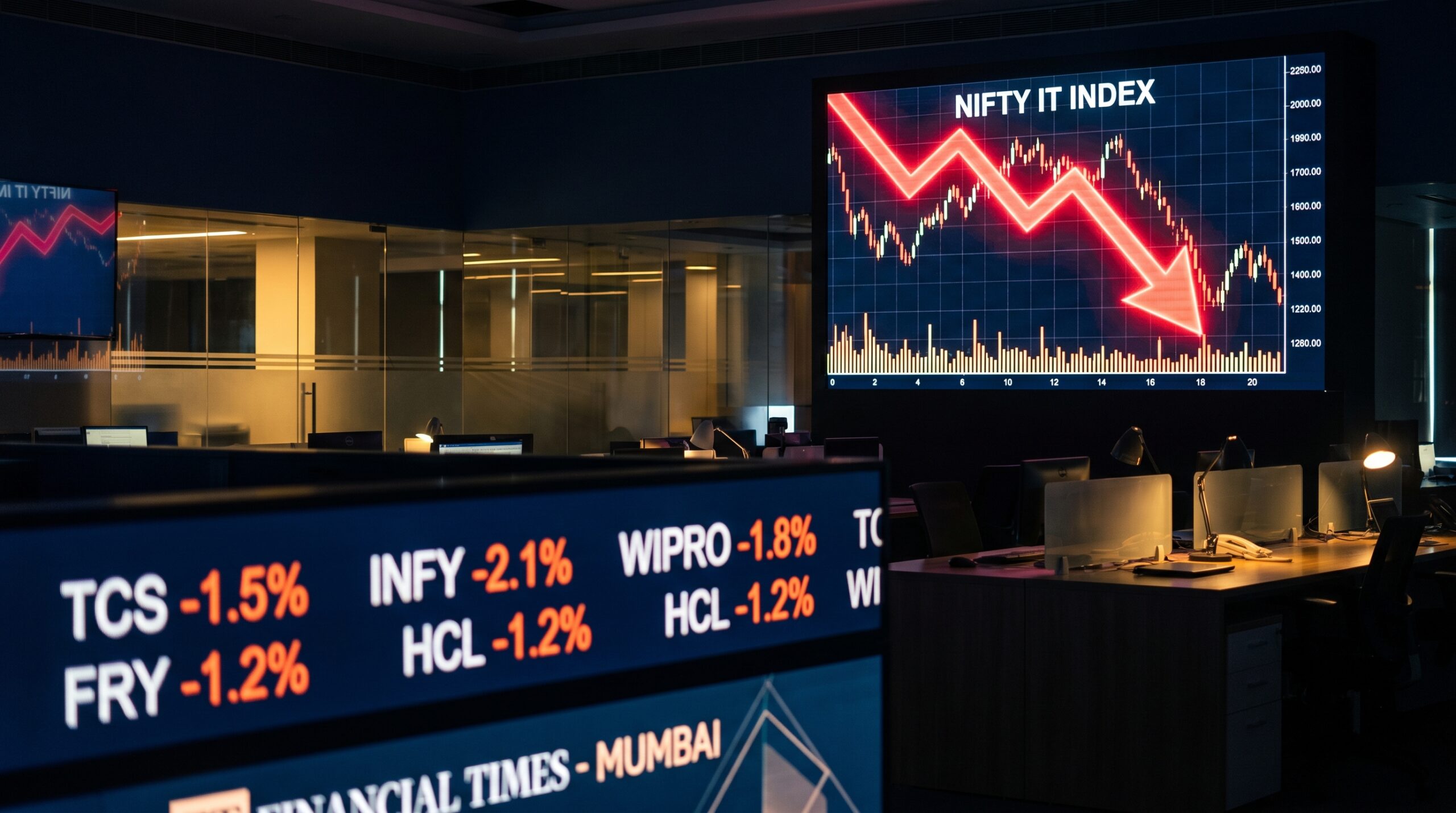
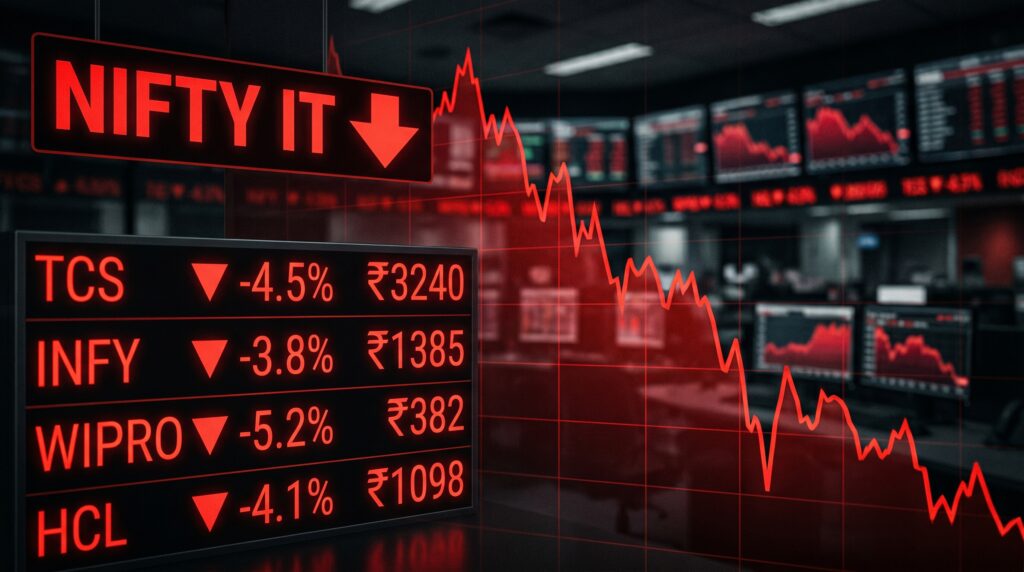
The Nifty IT index — which tracks India’s top 10 listed software companies — is down approximately 25% in 2026. It is the single worst-performing sectoral index on Dalal Street this year.
To put that in context: while the broader Nifty 50 has fallen roughly 10% in the same period, IT stocks have fallen more than twice as much. The Nifty IT index touched a 30-month low of 30,054 on February 24, 2026 — its weakest reading since August 2023.
In a single week during the peak sell-off, ₹1.51 trillion in market capitalisation was erased from Indian IT stocks. Not over a quarter. In one week.
TCS specifically, in FY2026:
- Recorded a headcount reduction of 23,460 — ending the year at 584,519 staff, down from over 607,000
- Saw annual revenue slip 0.5% year-on-year in dollar terms
- Reported a 13.9% year-on-year decline in net profit in Q3 FY26
- Saw constant currency revenue fall 3.1% in Q1 FY26 — one of its weakest showings since the pandemic
This is not a temporary demand blip. This is structural. And the word that every IT CEO is now using — carefully, reluctantly — tells you exactly why.
That word is “AI deflation.”
Truth #2: AI Deflation Is Real, and It Is Already in Your Earnings Reports
AI deflation is not a buzzword invented by analysts. It is an economic mechanism that is quietly rewriting the revenue model of every Indian IT company.
Here is how it works in plain terms:
India’s IT sector built its $283 billion empire on one straightforward model — bill clients by the hour, by the person, by the project. More engineers working on a problem meant more revenue. That equation has powered TCS, Infosys, Wipro, and HCL for three decades.
AI breaks that equation.
When a tool can write, test, and document code in minutes — code that previously required a team of engineers working for weeks — clients simply do not need to pay for as many hours. When AI handles software testing, legacy system modernisation, and documentation automatically, billing volumes compress.
Clients are no longer buying ‘effort’ — they are buying outcomes. When an AI agent completes in 4 minutes what a junior developer took 4 hours to do, the Time and Material billing model stops making sense. Clients know this. That is why they are demanding 20–30% price reductions, according to HFS Research.
HCL’s CEO C. Vijayakumar warned that future revenue will dip 3–5% in the coming year due to AI deflation. Infosys CEO Salil Parekh acknowledged deflation will become a factor this year. TCS CEO K. Krithivasan used the word “degrowth” in an earnings call.
These are not analysts speculating. These are the CEOs of India’s largest companies, describing their own businesses.
HSBC’s sector analysis goes further — projecting a 14–16% AI deflation impact across IT revenues over the medium term, based on a sub-segment-by-sub-segment model across 13 revenue categories.
Truth #3: OpenAI and Anthropic Are Replacing Billable Hours, Not Just Jobs
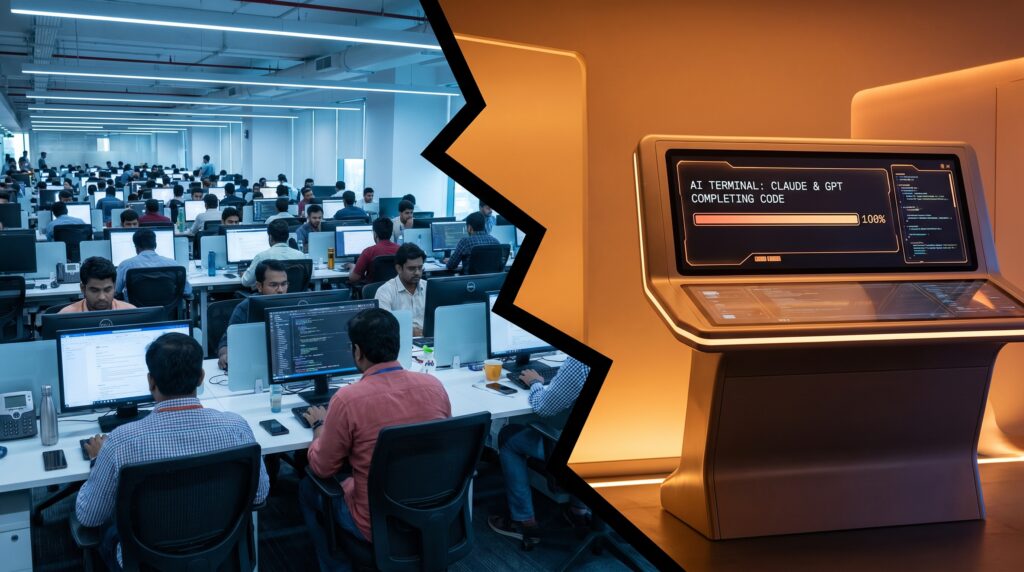
“AI will disrupt IT” is too vague to act on. The specific threat vectors are what matter.
OpenAI — The Enterprise Code Machine
OpenAI’s enterprise products — particularly GPT-4o and the Codex-based tools now integrated into GitHub Copilot — are deployed at scale inside the same Fortune 500 companies that pay TCS, Infosys, and Wipro billions annually. When a JPMorgan developer can generate 60–70% of their boilerplate code using Copilot, they need fewer offshore developers reviewing and writing that same code. Deal sizes shrink. Renewal rates compress.
Anthropic — The Workflow Automation Layer
Anthropic’s Claude has expanded aggressively into enterprise workflow automation in 2026. The products that matter most to IT services companies are not the chatbot. They are the agentic tools — AI that can autonomously browse systems, write reports, handle customer service escalations, and process documents without human intervention.
Analyst coverage specifically cited Anthropic’s launch of new workplace automation tools and plugins as a direct trigger for the Nifty IT sell-off sessions where TCS and Infosys fell 3–6% in a single day. Every task that Claude automates is a task that was previously billed at hourly IT consulting rates.
This is why the sell-off has not been irrational panic. It is the market beginning to price in a structural shift that the IT companies themselves have acknowledged. And it is only getting deeper — agentic AI specifically is the final threat to India’s BPO and software testing segments, where entire delivery teams exist purely to do what an AI agent can now do autonomously. If you want to understand exactly how this works, read our complete guide to Agentic AI for Indian investors.
Truth #4: Not All IT Companies Will Come Out of This Equally
Here is where an honest analysis demands balance. Because the disruption story is real — but so is the adaptation story. Both are playing out simultaneously inside the same companies.
TCS: Pivoting to AI-First, but Slowly
TCS currently oversees 620 AI engagements — the largest pipeline of any Indian IT firm. Its annualised AI revenue reached $2.3 billion by end of FY26, up from $1.8 billion the prior quarter. The flagship platform driving this is TCS AI WisdomNext — an enterprise AI suite that consolidates machine learning, generative AI, and data operations into one layer for large clients.
The growth rate is strong. The number in context of TCS’s total revenue base — tens of billions — is modest. When TCS describes workforce reduction as a “future-ready transformation,” it is retraining engineers for AI-augmented delivery. The company has made 25,000 campus offers and plans to hire 40,000 freshers annually, suggesting a future of fewer but more productive, AI-enabled engineers.
Whether margins recover during that transition is the central question.
Infosys: The Most Aggressive AI Partnerships
Infosys has announced partnerships with both OpenAI and Anthropic — positioning itself not as a victim of AI disruption but as the company that deploys, customises, and manages these tools for enterprise clients. Infosys manages 460 generative AI initiatives through its Infosys Topaz platform — a purpose-built AI suite that the company is actively pitching to replace traditional enterprise software contracts. Its CEO has signalled that AI-related revenue grew significantly from Q3 to Q4 FY26.The bet: the transition from AI pilots to production-scale deployments creates a new service layer that Indian IT can capture.
HCL Tech: The Quiet Frontrunner
HCLTech has secured $2.4 billion in AI-driven contracts by Q1 FY26 — including a partnership with Western Union using Google Cloud’s Gemini models to process 2 billion transactions annually. HCL has been more aggressive than its peers in positioning itself as a cloud-and-AI infrastructure company rather than a traditional services firm.
The market has punished it alongside its peers — but its contract wins suggest its AI pivot may be the most substantive.
Wipro: Most Cautious, Most Exposed
Wipro has acknowledged AI deflation pressure but has been the least forthcoming with concrete AI revenue figures or named partnership wins. In a disruption cycle, companies that partner with the disruptors tend to survive better than those still describing AI as a “future opportunity.”
The Bull Case Nobody Is Talking About
Here is the contrarian argument worth keeping in mind. Legacy “billable hours” are dying — but “AI Transformation” projects are high-margin. An AI Architect billing at $500 per hour replaces ten QA testers billing at $50 per hour. The revenue line may shrink. But if TCS and Infosys successfully reposition as AI implementation partners rather than staffing vendors, EBITDA margins could theoretically expand even as headcount falls. This is not guaranteed — but it is the bull case the market is currently ignoring entirely. Watch margin trends in FY27 results as the clearest signal of whether this transition is real.
Where Each Company Stands: FY2026 Snapshot
|
Company |
FY26 Revenue Growth |
AI Revenue / Contracts |
Headcount Change |
Stock YTD |
|---|---|---|---|---|
|
TCS |
−0.5% YoY (USD) |
$2.3B annualised |
−23,460 |
~−20% |
|
Infosys |
+3.1% (FY25 base) |
460 GenAI initiatives; OpenAI + Anthropic partnerships |
Stable |
~−20% |
|
HCL Tech |
Growing |
$2.4B AI contracts |
Growing slightly |
~−16% |
|
Wipro |
Flat to negative |
AI deflation acknowledged; limited concrete wins |
Reducing |
~−20% |
|
— |
— |
— |
−25% |
🐢 Gyani Turtle Sentiment Score
|
Company |
Turtle Score |
Signal |
|---|---|---|
|
HCL Tech |
🐢🐢🐢🐢 |
Strongest AI pivot, concrete contracts |
|
Infosys |
🐢🐢🐢 |
Named partnerships, Topaz platform live |
|
TCS |
🐢🐢 |
Large pipeline, transition still early |
|
Wipro |
🐢 |
Acknowledged risk, limited concrete action |
Truth #5: Your TCS SIP Needs a New Framework — Not a Panic Exit

Here is the question every reader came for. Let us answer it directly.
Should You Continue Your TCS SIP in 2026?
The honest answer has three parts — depending on how you hold TCS. But before the framework, one mental model worth internalising: don’t let a 12-month cycle break a 120-month plan. Most Indian investors have never seen their IT SIP go this red. That emotional discomfort is real — but it is also exactly the moment where patient investors separate themselves from reactive ones. The Nifty IT index has recovered from every previous correction. The question this time is not whether it recovers — it is whether the underlying companies recover differently than before.
If you hold TCS through a diversified large-cap mutual fund:
Do nothing. TCS is one holding among many. Your fund manager is already making allocation decisions. Stopping a SIP because of one stock in a diversified fund is an overreaction. The fund will rebalance naturally.
If you hold TCS directly as a stock:
This requires more thought. TCS at current prices is not obviously expensive — the stock has corrected meaningfully and forward valuations are more reasonable than a year ago. The honest question to ask yourself is: Do I believe TCS successfully transitions to an AI-augmented delivery model in the next three to five years? If yes — the current price may represent an attractive entry. If you are genuinely unsure — size down, not out.
If your portfolio is heavily concentrated in Nifty IT:
This is the most important case. A portfolio that is 30–40% Nifty IT is not a diversified portfolio — it is a concentrated bet on one sector undergoing structural change. Reducing IT sector concentration and redeploying into broader index funds is rational risk management, not panic selling.
The Three Things to Watch — Instead of the Share Price
1. Distinguish between sentiment and structure. The Nifty IT sell-off has been partly sentiment — fear running ahead of actual earnings damage. Q4 FY26 results were not as bad as many feared. But the structural pressure from AI deflation is real and multiyear. Both things are true at the same time.
2. Watch AI revenue as a percentage of total revenue. TCS’s $2.3 billion in AI revenue sounds significant — until you realise it is roughly 5–6% of total revenue. When that number crosses 20–25%, the transition is genuinely working. Until then, AI revenue is a promising indicator, not a rescue.
3. Favour adapters over resisters. HCL Tech and Infosys — both with concrete, named AI partnerships and contract wins — are better positioned than companies still describing AI as a vague future opportunity. In a disruption cycle, companies that work with the disruptors survive better than those that try to compete with them.
The Gyani Turtle Verdict

Your TCS SIP is not “unsafe” in the sense of catastrophic collapse. TCS is not going bankrupt. It has over $5 billion in cash, a global client base, and decades of institutional relationships that do not disappear overnight.
But the TCS SIP is no longer the low-risk, steady-compounder story it was from 2010 to 2022. TCS share price is down roughly 20% in 2026 alone — and the business model that powered those earlier returns — more people, more hours, more revenue — is under structural pressure that every senior leader in the company has now acknowledged using the word “deflation.”
The next five years for Indian IT will not look like the last five.
Here is the patient investor’s playbook:
- Hold IT through diversified funds rather than concentrated direct positions
- Reduce — do not exit — if your IT allocation exceeds 20% of your equity portfolio
- Watch the right metrics: AI revenue as % of total; contract structure (outcome-based vs time-and-material); revenue per employee
- Revisit in 12 months — FY27 numbers will clarify whether AI deflation is stabilising or still accelerating
OpenAI and Anthropic have not killed India’s IT industry. But they have permanently changed the rules of the game that built it.
The companies that understand this — and the investors who watch the right metrics — will come out the other side in better shape than those who either panicked or looked away.
Invest patiently. Analyse deeply. React rarely.
That’s the Gyani Turtle way. 🐢
Also read:
- Silicon Nationalism: Why Apple Just Hired Its Most Famous Ex to Build Its Chips
- How to Use Agentic AI in Investment and Trading — A Complete Guide for Indian Investors
- Start Investing in India — Best Essential Beginner’s Guide 2026
Disclaimer: This article is for educational purposes only and does not constitute investment advice. Please consult a SEBI-registered advisor before making investment decisions.

At Gyani Turtle, we believe every Indian deserves access to honest, jargon-free financial education. Our team simplifies investing, mutual funds, and personal finance — so you can build real wealth, one smart decision at a time. Not SEBI registered. For educational purposes only.