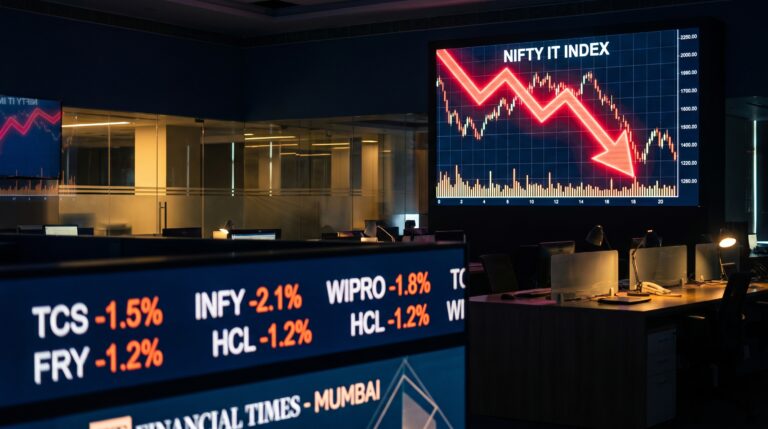
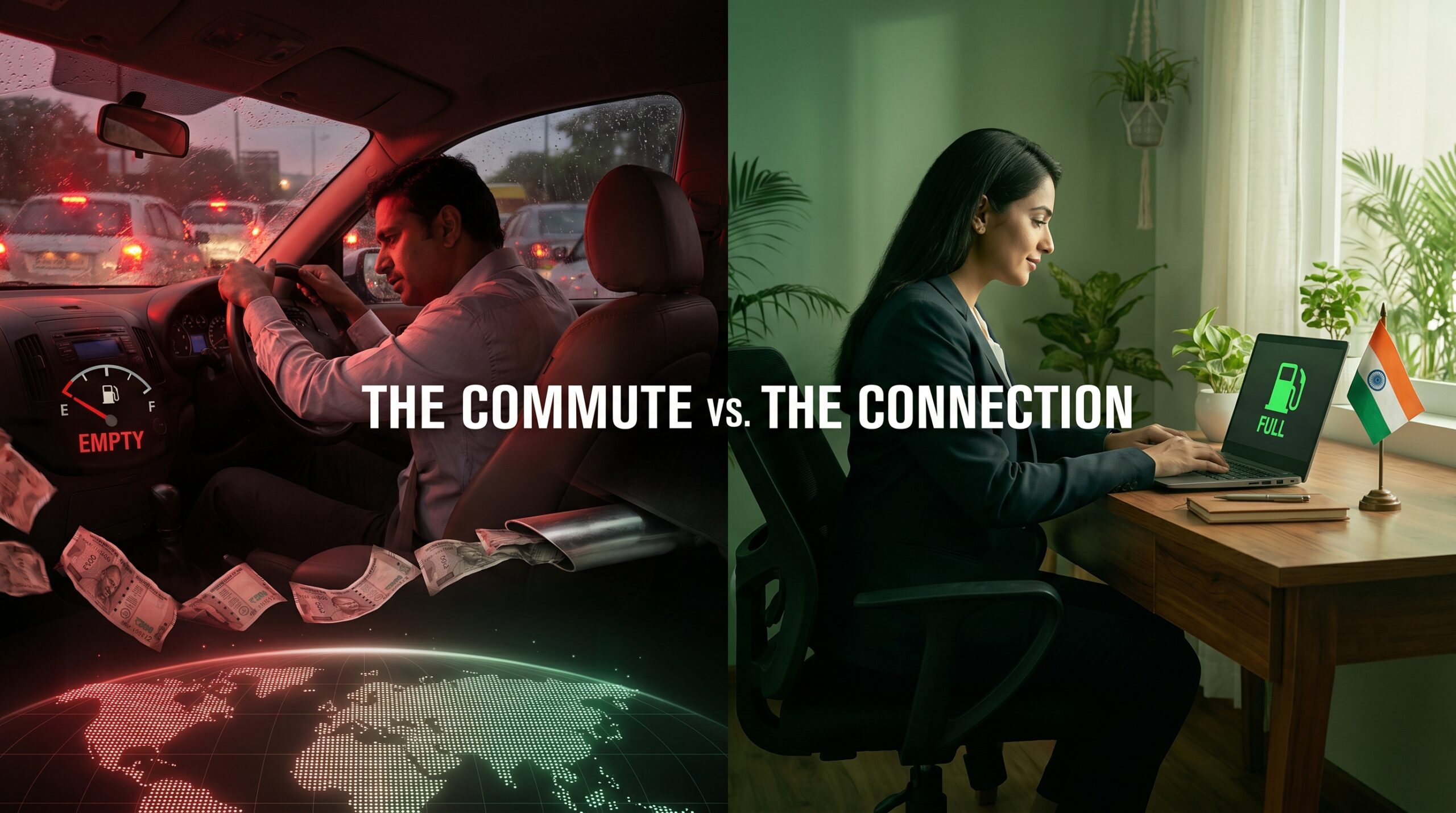
Your Car Is Costing India a War — Why Working From Home Is Now an Act of Patriotism
PM Modi WFH appeal, what’s the reason behind ?
The 30-Second Sip: India imports 85% of its oil. Crude just crossed $126 a barrel. State oil companies are absorbing losses of ₹10–12 per litre to protect you from the full price shock. PM Modi WFH appeal, carpooling, and freight rail isn’t soft advice — it is a fiscal emergency response. Every litre you don’t burn is a rupee India doesn’t have to defend. Here’s what the numbers actually say.
Every morning, millions of Indians start their cars, sit in traffic, burn fuel, and think nothing of it. It feels like a routine. A commute. A personal choice.
But on May 11, 2026, with crude oil above $126 a barrel and the Strait of Hormuz functioning as a geopolitical toll booth for 20% of the world’s oil supply, that commute is no longer just your problem.
It is India’s balance of payments problem. And PM Modi said so directly.
The $126 Barrel Nobody Is Discussing at Dinner
Let’s start with the number that should be on every Indian family’s mind: crude oil is above $126 per barrel.
This is not normal. For context, India’s entire fiscal planning for FY26 was done assuming oil at roughly $85–90 per barrel. The gap between that assumption and today’s reality is being absorbed by the government — and by you, invisibly, through inflation.
India imports 85–88% of its crude oil. That means every dollar rise in crude prices costs India approximately $1.7 billion per year in additional import spending. The journey from $85 to $126 has cost India roughly $70 billion in additional oil import bills — equivalent to wiping out nearly the entire gold import bill on top of normal crude spending.
The state-run oil companies — IOC, BPCL, HPCL — are currently absorbing losses of ₹10–12 per litre to prevent domestic fuel prices from exploding. They are taking the hit so your petrol pump price doesn’t reflect the full global reality.
But this subsidy has a cost. Every rupee of under-recovery reduces the funds available for infrastructure, healthcare, and MSME lending. And this buffer cannot hold indefinitely.
“Every litre of fuel India doesn’t need to import is a rupee the RBI doesn’t have to defend. Conservation is not sacrifice — it is fiscal self-defence.”
The WFH Number That Changes Everything
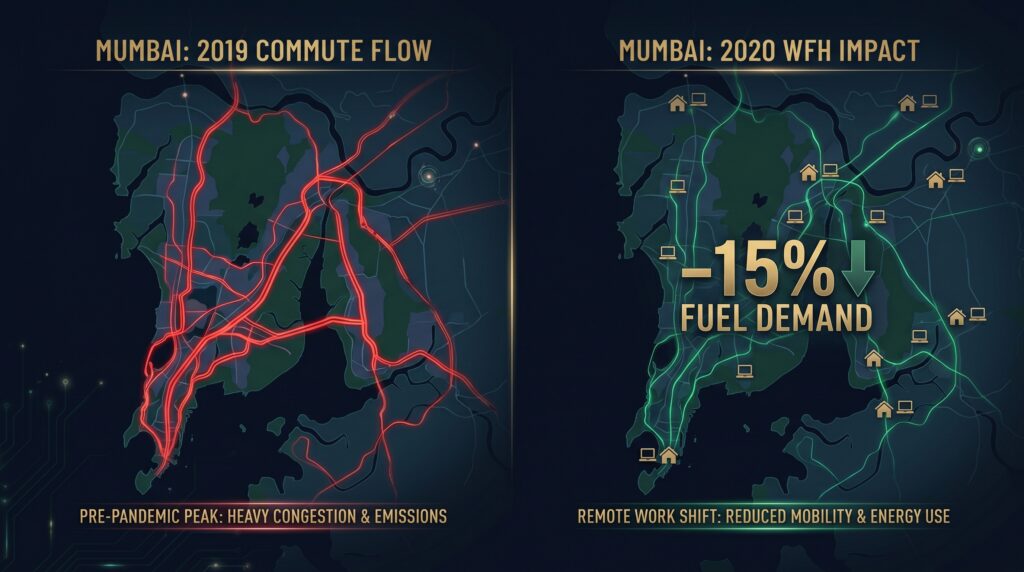
During COVID-19, when work-from-home became mandatory for India’s service sector, something measurable happened to urban fuel demand: it dropped by nearly 15%.
That is not a rounding error. That is millions of litres of imported oil that did not need to be purchased. Billions of rupees that stayed inside India’s forex reserves. A measurable, verified impact — achieved simply because people stopped commuting.
PM Modi is now calling for a voluntary return to this model — not because of a virus, but because of an economic emergency that is equally real, even if it is less visible.
If India’s IT, banking, and service sector firms shift 30–40% of their workforce back to WFH for the next 6–12 months, the fuel savings at a national level would be in the billions of dollars.
Consider the individual math:
|
Commute Type |
Monthly Fuel Spend |
Annual Fuel Spend |
CO2 Impact |
|---|---|---|---|
|
Daily solo car commute (25 km/day) |
₹4,500–6,000 |
₹54,000–72,000 |
~2.4 tonnes |
|
3-day WFH, 2-day office hybrid |
₹1,800–2,400 |
₹21,600–28,800 |
~1.0 tonne |
|
National saving (10M workers WFH) |
— |
₹2.5–4.3 lakh crore |
Significant |
At national scale, this is not a lifestyle suggestion. It is a macroeconomic intervention.
The Carpool Equation: Simple Math, Massive Impact
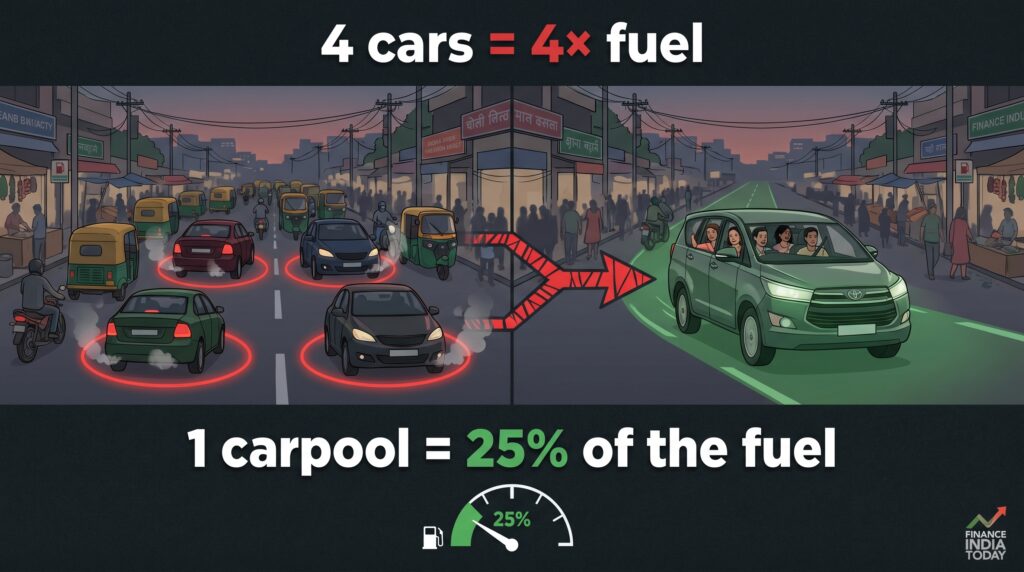
For those who must commute, PM Modi’s appeal is simple: don’t travel alone.
Carpooling sounds like a minor lifestyle change. But scale it:
- 4 solo cars = 4 units of fuel consumed
- 1 carpool of 4 people = 1 unit of fuel consumed
- Net saving: 75%
If just 10 million of India’s 300+ million vehicle owners carpooled with one additional person on their daily commute, the national fuel saving would exceed 3 billion litres per year — reducing India’s crude import bill by approximately $3–4 billion annually at current prices.
This is what PM Modi has framed as “Civic Satyagraha” — voluntary sacrifice for collective good, in the tradition of India’s non-violent resistance movements. The enemy this time isn’t a colonial power. It is a global supply chain shock. And the weapon of resistance is not a march, but a shared ride.
The Hidden War: Trucks vs. Railways
One of the most structurally important — and most overlooked — points from the PM’s address was this: move goods from trucks to railways.
The economics here are stark:
|
Freight Mode |
Fuel Efficiency |
Cost per tonne-km |
CO2 per tonne-km |
|---|---|---|---|
|
Road (truck) |
1× baseline |
₹2.5–3.5 |
High |
|
Rail |
3× more efficient |
₹1.0–1.5 |
Low |
|
Savings by shifting to rail |
67% fuel reduction |
40–57% cost saving |
Significant |
India moves approximately 70% of its freight by road. This is dramatically more road-dependent than comparable economies — China moves roughly 50% by road, Europe less than 30%.
Every truckload of goods that can be shifted to rail reduces:
- Diesel consumption (directly cutting oil imports)
- Logistics costs for businesses (reducing inflation)
- Wear on national highways (reducing maintenance spending)
This is a longer-term structural shift. But businesses that begin optimising supply chains toward rail — particularly for bulk commodities, FMCG distribution, and manufacturing inputs — will have a structural cost advantage as fuel prices remain elevated through 2027.
How Your Morning Commute Raises the Price of Tomatoes
This is not an exaggeration. This is supply chain economics.
Here is the chain that connects your car to your vegetable bill:
- Oil rises to $126 due to Hormuz disruption
- India’s import bill increases — more dollars leave India
- The rupee weakens against the Dollar
- Diesel prices rise — or oil companies absorb larger losses
- Truck transport costs increase across every supply chain in India
- Farmers face higher input costs — fertiliser, irrigation, machinery
- Wholesale food prices rise as logistics costs are passed on
- Your grocery bill increases — even if you don’t own a vehicle
Economists call this “imported inflation.” And it is already happening.
Every Indian who carpools, works from home, or takes the metro instead of driving is, in a small but real way, fighting the price of their own vegetables. This is not metaphor. This is supply chain mechanics.
What You Can Do — Starting Tomorrow
This is not a call for grand gestures. It is a call for small, consistent ones that compound at national scale:
For individuals:
- Work from home at least 2–3 days per week if your role allows
- Carpool with colleagues or neighbours who share your route
- Use public transport, metro, or cycling for sub-5-km trips
- Combine errands into single trips instead of multiple outings
- Avoid peak-hour driving when idling burns maximum fuel
For employers and HR teams:
- Implement or reinstate hybrid work policies for eligible roles
- Frame WFH as a national contribution, not just an employee perk
- Review logistics contracts — are vendors using rail where possible?
- Set fuel efficiency targets for company fleet and logistics
For businesses with logistics exposure:
- Audit your freight mix — what percentage moves by road vs. rail?
- For bulk or non-perishable goods, railway options are increasingly competitive
- Monitor IOC/BPCL subsidy sustainability — a fuel price correction is a planning risk
The Gyani Turtle Verdict
India is fighting an energy war. It is not being fought with weapons — it is being fought with consumption habits.
State oil companies are absorbing ₹10–12 per litre to shield you from the full impact of $126 oil. That shield has a cost — and a limit. The more Indians reduce fuel consumption voluntarily now, the longer that shield holds, and the less painful the eventual correction will be.
PM Modi’s appeal for fuel conservation is not government theatre. It is a rational, urgent response to a crisis that most Indians are not fully aware of.
Every litre of fuel not burned is a small victory in India’s balance of payments war. Every commute replaced by a video call is a rupee defended. Every carpool is an act of economic resistance.
The question is: will you answer the call?
Invest patiently. Analyse deeply. React rarely.
That’s the Gyani Turtle way. 🐢
Try Our Free Calculators
- Planning Retirement ? Calculate your FIRE number : FIRE Number Calculator
- Don’t miss SIP, find out how much you can worth with just a small amount : SIP Calculator
- Finding ways to end your EMI’s, calculate and visualize here : EMI Calculator
Disclaimer: This article is for educational purposes only and does not constitute investment advice. Please consult a SEBI-registered advisor before making investment decisions.

At Gyani Turtle, we believe every Indian deserves access to honest, jargon-free financial education. Our team simplifies investing, mutual funds, and personal finance — so you can build real wealth, one smart decision at a time. Not SEBI registered. For educational purposes only.